65,000 Hours on Digit 4 Are Meant to Justify Digit 5 — Field Testing No Earlier Than 2027
When Agility Robotics unveiled Digit 5 on September 15, 2026, it was two announcements in one. The first concerns engineering: the next generation of the company's general-purpose humanoid robot, described as built for "cooperatively safe"…

65,000 Hours on Digit 4 Are Meant to Justify Digit 5 — Field Testing No Earlier Than 2027
When Agility Robotics unveiled Digit 5 on September 15, 2026, it was two announcements in one. The first concerns engineering: the next generation of the company's general-purpose humanoid robot, described as built for "cooperatively safe" work at scale, able to work closely with humans without the physical safety barriers traditional automation requires. The second concerns capital: the announcement lands while the company seeks to go public through a SPAC merger at a $2.5 billion valuation — against $1.8 million in 2025 revenue and an order book of more than $300 million that turns out to be heavily concentrated in a single customer agreement.
What Agility actually announced
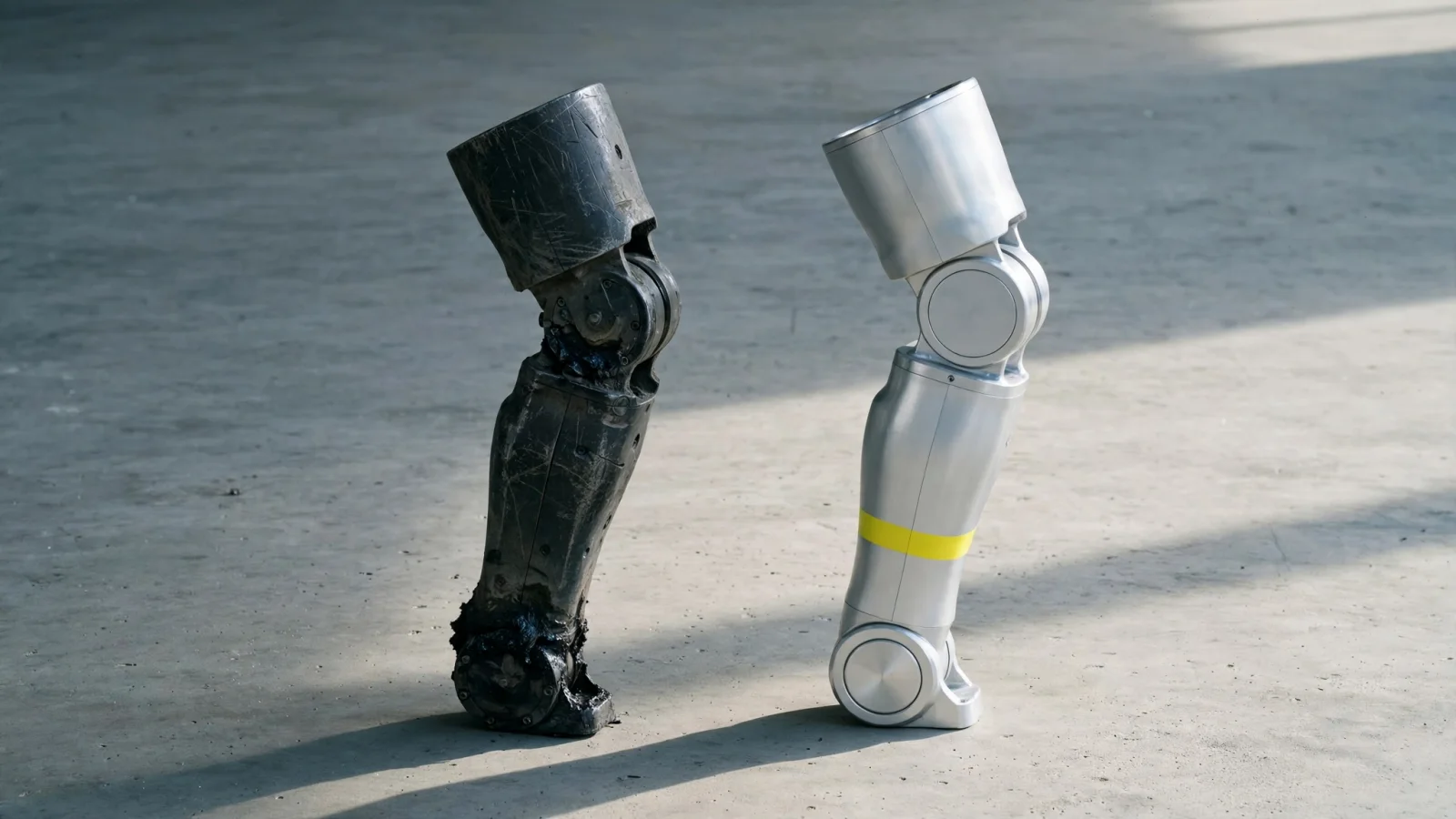
According to the press release (PR Newswire), Digit 5 is the next generation of the company's general-purpose humanoid robot. The core message is that the robot should be able to work near people without the physical safety barriers traditional automation requires.
The technical specifications — all of which are the company's own claims and not independently verified — include:
- 40% more payload: A new leg design built for repetitive lifting, powered by the company's proprietary cycloidal actuators, is said to enable lifting up to 50 pounds (22.7 kg) repeatedly — up from roughly 35 pounds on Digit 4. Agility notes this covers the full range of one-person lifting tasks in OSHA-regulated facilities.
- Battery and charging: 90 minutes of runtime and nine-minute charging yield a 10:1 run-to-charge ratio, up from 2:1 on Digit 4. That is said to make more than 20 hours of work per day possible.
- Safety architecture: An independent safety controller monitors responses when humans are within unsafe distances and "immediately triggers the appropriate safety responses," combined with AI-based human detection and visual/audible safety signals.
- NVIDIA partnership: Agility is the first launch partner for NVIDIA's Halos for Robotics platform, paired with NVIDIA IGX Thor and Halos Core. NVIDIA's Deepu Talla is quoted in the same press release.
The timeline: early access is expected in the first half of 2027, with general availability to manufacturing, warehouse, and distribution operators by the end of 2027. The company plans its first deployments outside North America in the EU and the UK, with CE marking, according to The Robot Report.
The order book: $300 million — with a caveat
The announcement also cites more than $300 million in multi-year customer orders as of May 2026, according to Unite.AI. But the figure carries two important caveats.
First, the orders are "contingent on the fulfillment of certain contractual milestones" — this is not secured revenue. Second, securities filings show the headline number is heavily concentrated in a single customer agreement, according to TechRepublic. The customer's identity and the terms of the milestones are not disclosed in the available material.
The financials behind the valuation
The contrast with the $2.5 billion SPAC valuation is stark. According to SEC filings covered by The Robot Report, Agility had $1.8 million in net sales in 2025. Claims Journal reports roughly $1.8 million in 2025 revenue against a $140 million operating loss, nine customer facilities, $500 million raised to date, and a public listing via merger with Churchill Capital Corp XI.
Worth noting: the secondary sources vary slightly in wording (net sales versus revenue), and the underlying filings were not reviewed firsthand, so exact figures cannot be independently verified here. But the picture is consistent: a company in early commercialization, with an operating loss roughly 78 times its revenue, seeking public capital at a valuation that assumes humanoid commercialization succeeds.
The track record: three years of Digit 4
There is real operational data behind the launch. CEO Peggy Johnson ties the hardware changes to feedback from more than 65,000 operational hours with Digit 4 at customers including Amazon, GXO Logistics, and Toyota Motor Manufacturing Canada, according to TechRepublic.
Company co-founder Jonathan Hurst has described what the hours taught: during early deployments, the team ran into "the reality of FCC requirements, UL certifications, ISO certifications, and more that come with deployments." Performing the task alone, Hurst said, was not enough to deploy robots at scale — a recognition that explains why Digit 5 is marketed around safety architecture rather than just lifting capacity.
The standards gap no one has closed yet
Here lies the analytical core. The standards situation for fenceless, legged robots in shared workspaces remains unsettled — and it is Agility itself saying so. The company's own press release cites ANSI/A3 TR R15.108 and ISO 25785-1 as standards still under development.
Claims Journal also points out that legged humanoid robots like Digit are "more unpredictable and pose a greater safety risk" near people than comparable wheeled devices. That means fenceless operation on legs is precisely the use case where the safety regulatory framework is most underdeveloped.
It is also worth noting that the available material contains no independent certification of Digit 5's safety architecture; prior safety evaluations covered earlier Digit models. NVIDIA's Halos partnership and the independent safety controller are parts of an architecture not yet tested in the field — early access only arrives in 2027.
An industry, not an exception
Fenceless safety is not an Agility demand alone but a positioning the whole industry is moving toward: Apptronik is testing Apollo at a Mercedes-Benz plant with force-limiting control, and Boston Dynamics has unveiled a new electric Atlas with "human detection" and "fenceless safety control," planned for deployment at Hyundai's Georgia facility by 2028, according to Chosun Ilbo via MSN. The race to be "safe enough to stand next to you" has become a commercial differentiator before the standards meant to define it are finished.
The open questions
Three factors will determine whether the Digit 5 launch holds together as a story. Who is concentrated behind the $300 million in orders, and what milestones do they hinge on? Will there be independent certification of the safety architecture — and if so, by whom — before fenceless operation begins? And do the specifications hold up in the field, when early access only happens in 2027?
Until those questions are answered, "cooperatively safe" should be read for what it is: a company characterization of a product not yet in general operation, launched in a valuation context where the gap between $300 million in contingent orders and $1.8 million in actual revenue is a number worth watching.
Sources
- Agility’s New Digit 5 Robot Has $300M in Orders — But There’s a Catch — www.techrepublic.com
- Agility Robotics Debuts Digit 5 Humanoid With New Safety Architecture – Unite.AI — www.unite.ai
- Agility’s Digit 5 humanoid has new legs, batteries, safety upgrades — www.therobotreport.com
- Agility Robotics' Digit5 humanoid works safely without safety fences — www.msn.com
- Agility Unveils Humanoid That Can Work Safely Alongside People — www.claimsjournal.com
- Agility Unveils Digit 5 Humanoid Robot Built for Cooperatively Safe Work at Scale — www.prnewswire.com