

Helsing rented Kraftwerk Berlin for a military launch – without Tresor knowing about it
The Berlin arts complex has admitted a "serious error of judgement" after the defence technology company Helsing rented its central hall for the launch of the Clarity targeting system – and the bitterness of the city's club culture now collides with Europe's push for its own defence technology.
What happened
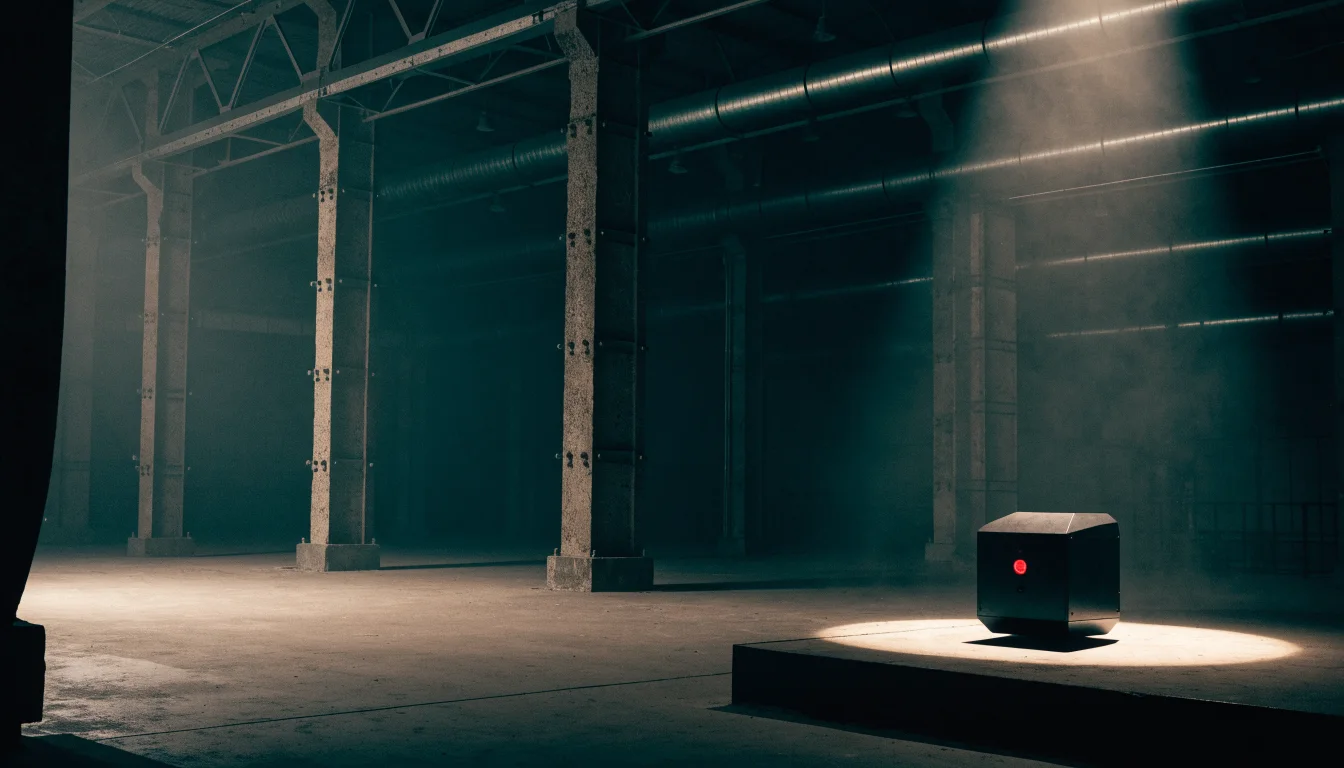
On 11 November 2026, the central hall of Kraftwerk Berlin, the Kulturkraftwerk building and one of the city's most symbolically charged techno landscapes, was transformed into a launch arena for the German military technology company Helsing. According to The Guardian, visitors described the staging as something resembling a war room: maps and aerial imagery projected onto the concrete walls, drones hanging from the ceiling and guards in bulletproof vests patrolling the premises with sniffer dogs (5f95956e).
What was launched was Clarity, a targeting and data analysis system that Helsing presents as a European challenger to the American Palantir's Maven. The occasion itself was not controversial within the defence industry – but the choice of venue was. Kraftwerk Berlin houses some of Berlin's most prominent club and cultural actors, and anger spread quickly through Berlin's music community. The week after the launch, The Guardian reported that the venue apologised for a "serious error of judgement" and promised to revise the booking policy of its commercial rental division (5f95956e).
What Clarity is – according to Helsing's own statements
Helsing, founded in 2021 and based in Munich, counts Spotify co-founder Daniel Ek among its investors and co-chairs of its board. On its own website, the company describes Clarity as an "agentic intelligence platform" developed to use drone, satellite and sensor data to lock onto targets (5f95956e).
At the 11 November launch, the company said, according to dpa, that the system can analyse large volumes of data to identify military resources, installations and positions, and that the information can be processed to help forces attack targets with suitable weapon systems (f2621fdb). Co-founder and co-CEO Gundbert Scherf emphasised the sovereignty argument: "A capability this critical must be sovereign. With Clarity, European armed forces get software that is built in Europe, runs on their own infrastructure and remains under their control," he said in a quote reported by dpa (f2621fdb).
The clearest example Helsing itself has put forward is a demonstration in September: according to SOFX, which attributes the figures to the company, Clarity reviewed commercially available reconnaissance data over selected areas of western Russia and Belarus and identified over 500 military objects. Operators approved each target, the company said, as part of a design that prevents the software from ordering attacks on its own (70792e32). The figure is thus Helsing's own claim, not independently verified.
Human-in-the-loop and the criticism of it
That the lines between targeting and attack are central to the case is reflected in Helsing's own presentations. Speaking to the German broadcaster RBB at the launch, a spokesperson said that none of the company's military systems are designed to identify people, and that Clarity is built to find objects such as radar installations, launch platforms and ships (5f95956e). At the same time, the spokesperson said, according to The Guardian, that the company's agents specialise in "searching for behavioural patterns" (5f95956e) – a statement suggesting a broader analytical scope than pure object recognition.
Critics are not reassured by the human-in-the-loop argument alone. Michail Stangl, a music curator and DJ in Berlin, points out that AI-driven targeting systems are already in use in Gaza, and warned that a commercially successful Helsing system could be resold to authoritarian regimes, police forces or Frontex. "That there is war in Europe and that Ukraine needs German support should not mean we switch off all our critical faculties," Stangl told The Guardian (5f95956e).
The criticism is not aimed at Helsing by name, but at a venue that in Berlin's club culture stands for something entirely different. Tresor and Tresor Records, based in the same building, issued a statement to Resident Advisor in which they wrote that "the event should not have taken place" and that "the promotion of weapons and military AI contradicts everything Tresor has stood for since 1991," according to Midnight Rebels' account (683ff99f).
The internal blunder
The controversial element, then, lies in the booking itself. According to Midnight Rebels, drawing on Resident Advisor, GROOVE and Mixmag, Kraftwerk's commercial rental division approved the Helsing booking without consulting the cultural organisations in the building. Sales manager Tjabo Reuter called it a "serious error of judgement", said he should have declined the enquiry, and promised that the event's surplus would be donated in full (683ff99f). RA reports, according to Midnight Rebels, that Reuter described the event as Kraftwerk Berlin being used as a platform to promote weapons and military AI in a single morning, and that he acknowledged serious damage to the venue's reputation (683ff99f).
GROOVE reports, according to Midnight Rebels, that Dimitri Hegemann, managing director of both Tresor and Kraftwerk Berlin, acknowledged that the booking was unacceptable – and that he too was unaware of it in advance (683ff99f).
Why this fits a larger European pattern
At its core, the case is less a local booking error and more a symptom of the pace of Europe's defence technology push. According to SOFX, citing Reuters, Germany has decided not to buy Palantir's Maven and plans its own AI-based data platform from 2027, with full use from 2028 (70792e32). France is building, according to the same reports, its own sovereign platform, called Arcadia, and the Netherlands wants a European replacement within two years (70792e32). In this landscape, Helsing positions Clarity explicitly as the sovereign European alternative, and Scherf's sovereignty argument is the company's central sales pitch.
What remains unresolved
Several questions remain open:
- Where the surplus will go. Kraftwerk Berlin has promised to donate the entire surplus, but it is unclear whether the donation has actually been paid out and who the recipients will be. According to Midnight Rebels, recipients are to be decided jointly by the four organisations in the building (683ff99f).
- Whether military customers are already using Clarity. Helsing has not disclosed whether military customers are already using the system, or when the software is expected to be operational, according to remio.ai citing Reuters (a1868686).
- Delivery to the Lithuania brigade. Reuters has reported, according to SOFX, that Helsing can deliver a first version of Clarity "within months" to the German army's Lithuania brigade, the Bundeswehr unit considered most exposed in any conflict with Russia (70792e32). This stands in some tension with the company's failure to publish a timeline for operational deployment.
- Helsing's response. The Guardian reports that Helsing did not respond to the newspaper's enquiries (5f95956e).
The story is still moving as of late November 2026. What the Kraftwerk affair has already shown is that Europe's defence tech industry is now growing faster than the cultural and institutional infrastructure around it can digest – and that in a building like Kraftwerk Berlin, with Tresor's history as its foundation, it is not enough that a system like Clarity actually has humans in the loop when the political and cultural significance of the venue was never assessed in advance.