


Hugging Face changes route: Inference Providers now goes through OpenRouter
On November 16, 2026, Hugging Face swapped the router behind Inference Providers from its own solution to OpenRouter. Code, token, and endpoint are said to be unchanged for developers — but which provider actually serves each call is now chosen by a third party based on live price, speed, and reliability.
What actually changed
Hugging Face announced on Monday, November 16, 2026 that it is switching Inference Providers from its own custom router to OpenRouter. In the blog post, signed by, among others, Julien Chaumond and Victor Mustar, the switch is phrased like this: "Requests made to language models now go through OpenRouter, which picks the best provider for each call based on live price, speed and reliability, and retries on another provider if the first one fails. Your code stays the same" (Hugging Face).
In practice, this means the request chain for supported language models now looks like this: your application → Hugging Face's router → OpenRouter's provider selection → model provider. OpenRouter routes each request across more than 80 providers based on its own live measurements, according to Hugging Face's announcement.
OpenRouter confirmed the switch from its side the same day: "Chat models on Hugging Face Inference Providers now run through OpenRouter's routing, and OpenRouter can send your traces to a Hugging Face Storage Bucket", according to OpenRouter's blog post. Worth noting: this is a listing entry, not the full post, so details about the trace logging currently rest on a short summary.
What did not change — at least not in the documentation
Hugging Face promises the code stays the same: the application continues to use a Hugging Face token and the Hugging Face endpoint. The router supports OpenAI's Chat Completions and Responses APIs as well as Anthropic's Messages API for every chat model, regardless of the provider behind it. The announcement also includes setup guides for coding agents such as Claude Code, Codex, OpenCode, Pi, and Hermes Agent.
Independent testing the same day
Kingy.ai, a third-party website, ran live tests of the new route the same day the migration happened. According to Curtis Pyke at Kingy.ai, 20 new API requests produced 15 completed responses; four returned expected authentication or validation errors, and one was interrupted. Along with earlier tests of the widget and two direct calls, 18 model responses completed in total.
The tests confirmed the documented request chain and showed concrete routing: Granite 4.2 8B was served via CoreWeave (the default choice, cheapest) and DeepInfra (fastest). Streaming, tool calls, and schema calls worked, and vision output was delivered via Qwen 3.8 27B on DeepInfra.
But Pyke has an important caveat that Hugging Face's "Your code stays the same" phrasing does not capture: an unchanged API call does not guarantee an unchanged provider, price, privacy agreement, or performance profile. Kingy.ai's list of what has not been established is long: continuity for existing tokens from before the migration, automatic failover, organizational billing, and reliability under the new routing are all untested.
Context: the growth of open-weight models
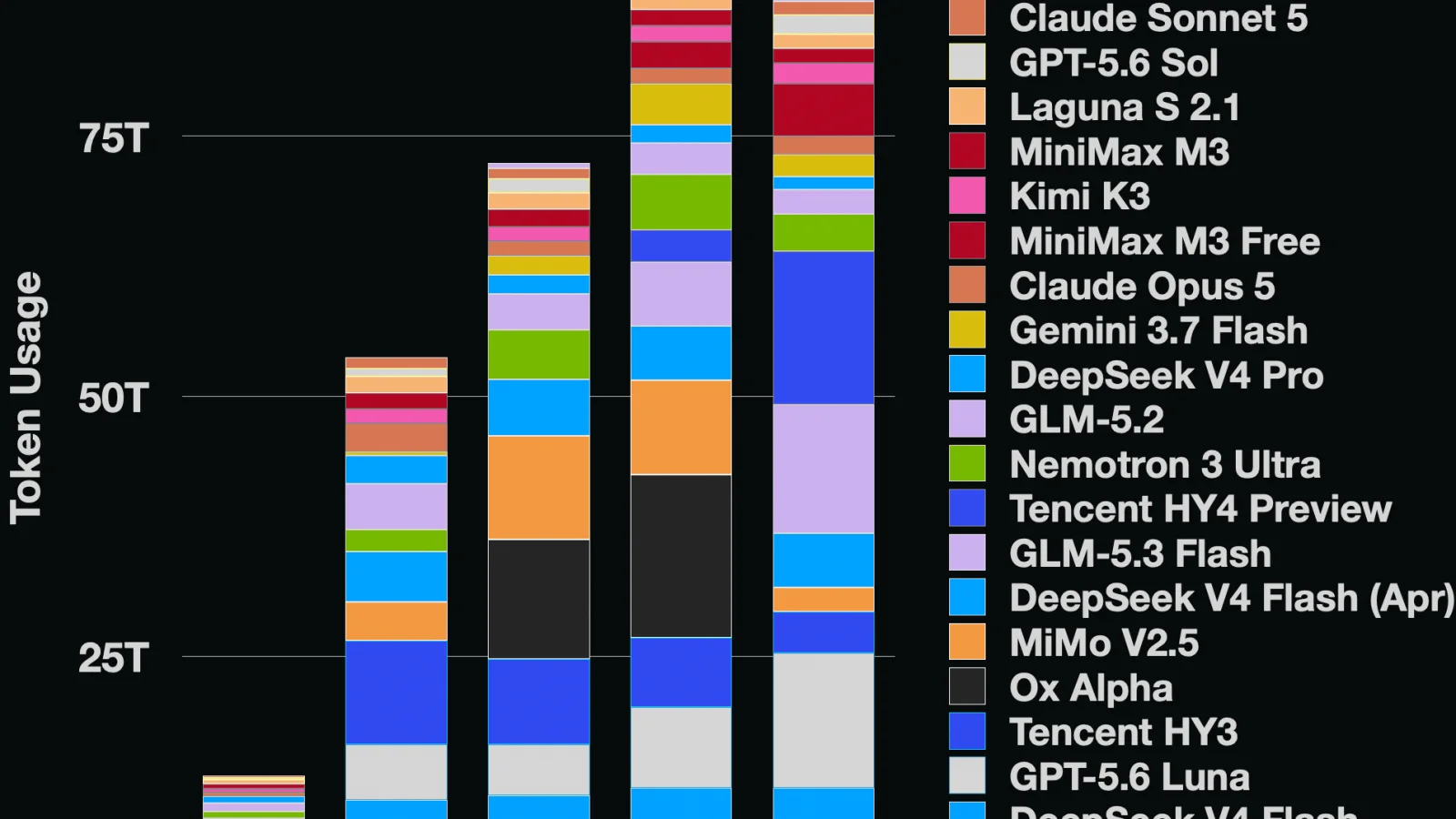
The switch comes at a moment Hugging Face itself describes as a breakthrough for open models. The figures, however, come from OpenRouter itself, relayed in Hugging Face's post, and are not independently verified:
- Open-weight models accounted for 26.8% of tokens on OpenRouter in October 2025, and 71.7% at the end of September 2026, with a peak of 77.5% in July (OpenRouter, October 2026).
- Weekly volume for open models grew more than 60-fold in the same period, against nearly 10-fold for closed models.
- On average, open models cost roughly four times less: $0.28 per million input tokens and $1.62 per million output tokens, versus $1.27 and $6.36 for closed models.
- At the same time, the best open models still lag on demanding benchmarks: Kimi K3.1 Pro scores 46 versus Claude Fable 5.2's 65 on the Artificial Analysis Intelligence Index, according to Hugging Face.
So these are the companies' own data and Composite figures they cite themselves — useful as context, but presented here with the attribution they require.
What developers should actually check
The switch itself is confirmed and working, according to both companies and the Kingy.ai test. What remains are questions with economic and practical consequences: Which provider serves your calls in practice, and does it change from call to call? Does the price you pay through Hugging Face match the provider OpenRouter actually selects? What privacy terms apply when trace data can be sent to a Storage Bucket? And do your tokens and billing — for example monthly credits on PRO and Team plans — work unchanged after the migration?
None of these questions are answered by today's documentation or tests. The practical conclusion for developers is therefore low-tech: log which provider serves your calls, and verify price and terms against your own account, rather than trusting that "the code is the same" means everything else is too.