

Maia 300 built on TSMC 2 nm: 13.8 PFLOPS FP4 and 950 watts per chip
ANNOUNCEMENT: Microsoft has presented its third-generation in-house AI accelerator, Azure Maia 300, with production rollout from 2027. The chip has 288 GB of HBM4 memory and 13.8 PFLOPS of FP4 performance, but the much-discussed efficiency figures remain the company's own measurements – no independent party has tested the chip.
The core of the story
On Monday, October 12, 2026, Microsoft announced Maia 300, the third generation of the company's in-house AI accelerator. According to UPI, the announcement is part of Microsoft's push to reduce its dependence on Nvidia and AMD hardware, by using its own chips for an ever-larger share of its AI infrastructure.
Satya Nadella, Microsoft's CEO, said according to TechPowerUp's account of the announcement that the company will scale the Maia family to multigigawatt rollouts, and that it is to become the company's primary AI inference system for its own products and services. Production rollout begins in 2027, according to Notebookcheck.
Maia 300 is designed for inference workloads – that is, running already-trained models, not training them. According to TechBooky and NaijaEyes Blog, this involves demanding tasks such as complex reasoning, long conversational applications and tasks performed by AI agents.
The specifications
The technical figures are detailed and consistent across the sources:
- Compute performance: up to 13.8 PFLOPS at FP4 precision and 6.9 PFLOPS at FP8 (Notebookcheck)
- Power: 950 W SoC power, versus 750 W for the Maia 200
- Memory: 288 GB of HBM4 across eight stacks, with total bandwidth of 18 TB/s
- Scaling: 3.2 TB/s scale-up bandwidth, 96 accelerators per rack, and clusters of up to roughly 12,000 chips
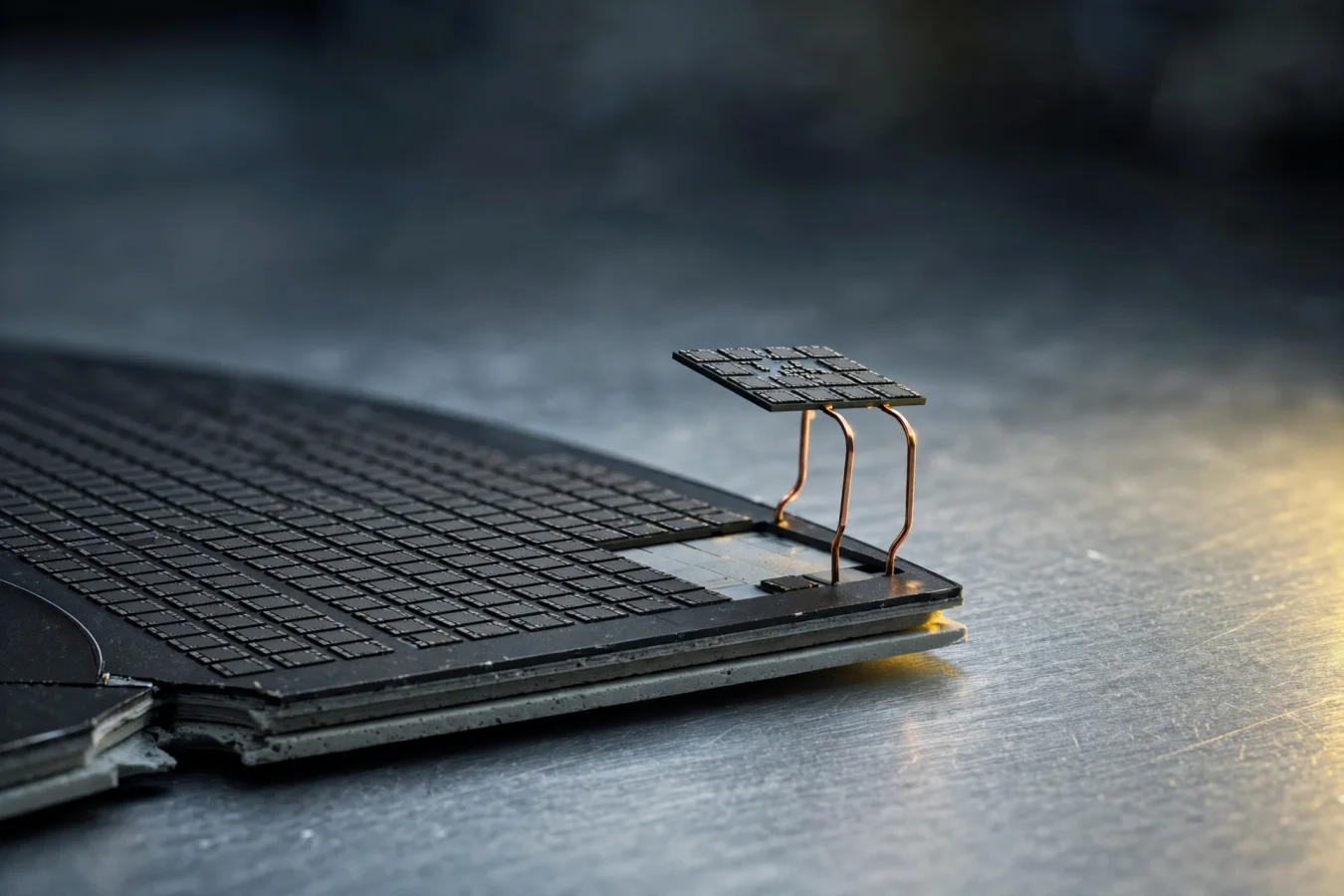
The architecture is a chiplet design built on TSMC's newest N2P node (2 nm), according to TechPowerUp, which describes a main compute die surrounded by two I/O dies on an older node and four DDR RDIMM memory tiles serving as system memory. Notebookcheck cites Reuters for the process node details.
The generational leap from Maia 200
Microsoft itself summarized the improvement over its predecessor. "Maia 300 delivers 2.5 times the memory bandwidth, 33 percent more capacity, and roughly 2 times the HBM bandwidth per watt compared to Maia 200," the announcement stated, as quoted by UPI.
Checking the figures against the Maia 200's specifications, they add up: the predecessor has 216 GB of HBM3e at 7 TB/s, over 140 billion transistors and over 10 petaFLOPS at 4-bit precision, according to Startup Fortune. With 288 GB and 18 TB/s in the Maia 300, the bandwidth jump is roughly as stated.
The context that gives the story weight
What distinguishes this announcement from pure promises of the future is that the predecessor is already in operation. Microsoft states that the Maia 200 is running production workloads, including Microsoft Copilot, as well as OpenAI models, Microsoft's own MAI models and open model families in Azure, according to Startup Fortune.
Services mentioned in connection with the Maia program are GitHub Copilot, Microsoft Foundry, Teams and Dragon Copilot (TechBooky). The Maia 200 is, according to TechPowerUp, being rolled out in regions in the US, Europe and Australia. Maia 300 is thus not an experiment, but a scaling of an established strategy.
The efficiency claims – with major caveats
The announcement's most aggressive figures are Microsoft's own, and they should be read with caution:
- 40 percent more tokens per megawatt than "leading GPU-based AI systems" – Microsoft has, according to Notebookcheck, "not provided sufficient details about the competing GPU configurations to independently determine the extent of the efficiency advantage."
- 70 percent more tokens per watt for the Maia 200 compared to "AI GPUs," measured across Copilot and Teams, according to TechPowerUp's account – this too is a company claim.
- Up to seven times rack-scale token throughput relative to the Maia 200 for a fully built-out configuration with 96 accelerators. TechBooky notes that this "should not be read as proof that a single Maia 300 chip is seven times faster than an Nvidia GPU" – the comparison concerns an entire rack against the predecessor, not one chip against competitors'.
Common to all three figures is that they have not been independently verified. No third-party companies had tested the Maia 300 as of the announcement day, according to UPI, and there is no price or date for when customers can rent Maia 300 capacity in Azure.
Scale and the market
The level of ambition is high: according to Reuters, as reported by Yahoo Finance, Microsoft could deploy more than one million Maia 300 chips next year. The company's share price rose about 1.07 percent on the announcement day. This figure, too, is a projection-flavored "could" – not a confirmed production plan – and it is reported secondhand.
The relationship with Nvidia
Despite the grand plans, Maia is not a complete Nvidia replacement. As Startup Fortune points out, Maia is intended to supplement GPUs for specific tasks, not replace them entirely, and Microsoft continues to buy large volumes of Nvidia hardware for workloads Maia is not built for. In practice, this is a division of labor: in-house chips for inference in well-known, frequent workloads, and commercial GPUs for the rest – including training, where the Maia chip by all appearances is not intended to compete.
Open questions
Several central questions remain unanswered after the announcement:
- No independent tests. The efficiency claims rest on Microsoft's own measurements without published comparison configurations.
- No price. Microsoft has not stated what the chip costs to produce or rent out.
- Unknown customer availability. So far there is no date for when Azure customers can gain access to Maia 300 capacity.
- Uncertain production volume. The million-chip figure from Reuters is a possible rollout, not a confirmed plan.
The Maia 300 announcement is concrete on the specifications and backed by a chip family already in production. But whether Microsoft's efficiency figures hold up in practice, we will probably not know until independent measurements are available – and no one has promised when that will happen.