

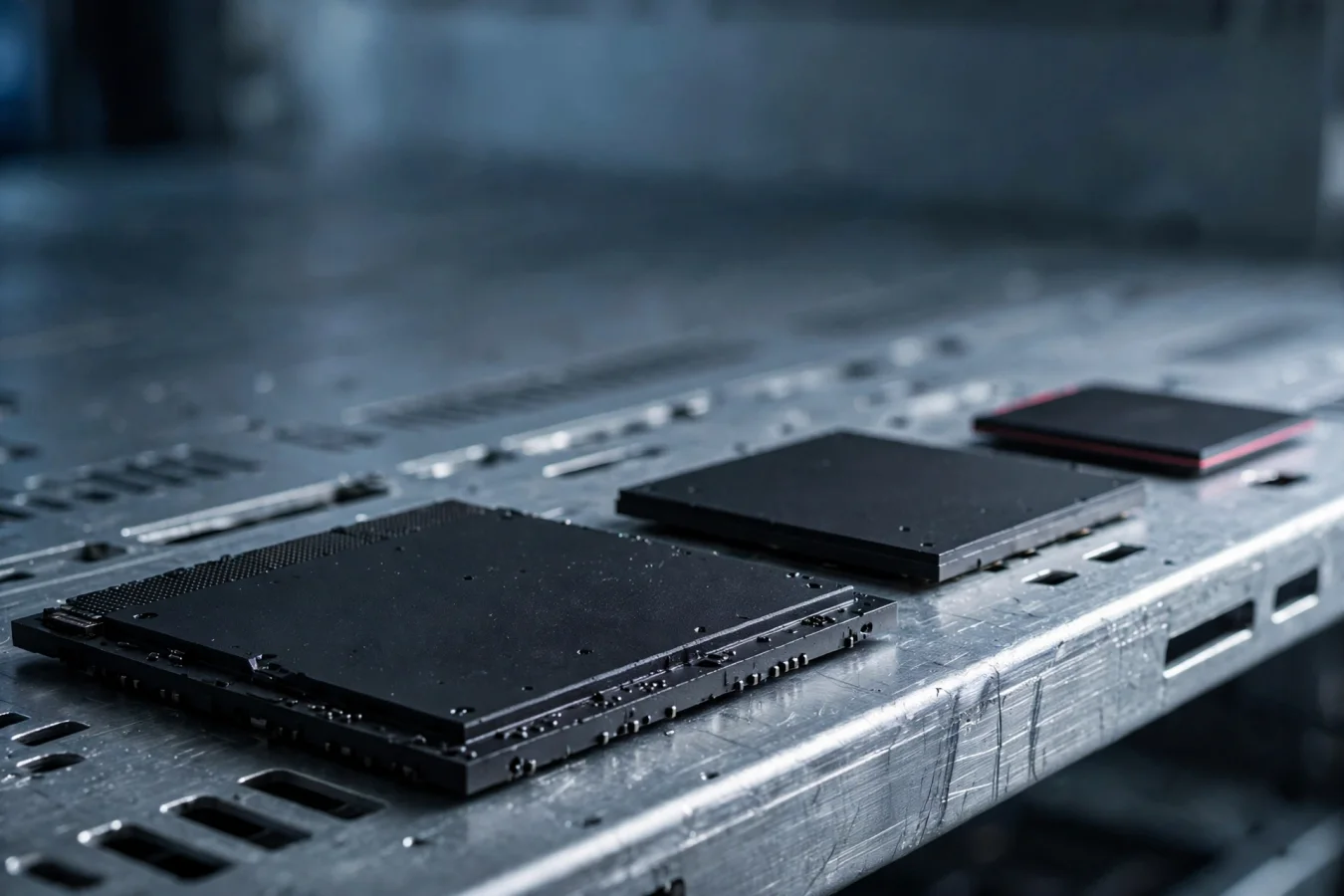
Maia 300 heads into Azure: Microsoft bets on its own inference chip from 2027
Microsoft has unveiled Maia 300, the company's third-generation in-house AI inference chip, with production rollouts across Azure data centers beginning in 2027. Its predecessor, Maia 200, is already in operation, and Microsoft is positioning Maia 300 as the primary system for AI inference across its own products and services — with claims of 40 percent more tokens per megawatt than leading GPU-based systems. All performance figures are, for now, the company's own expectations, not independent measurements.
What Microsoft announced
The announcement came in mid-October 2026, ahead of Microsoft Ignite 2026, which takes place next month. According to ETV Bharat (published October 13, 2026) [source: f9d407d8], the company says the Azure Maia family is to expand to multi-gigawatt-scale deployment from 2027, with Maia 300 as the main system for AI inference across Microsoft's products and services.
Lapaas Voices' coverage [source: d46e1c4e] describes the same message: Maia 300 is the third generation of in-house inference silicon, and the company is expanding its custom silicon infrastructure across Azure data centers from 2027. Maia 200 is thus in operation now; Maia 300 follows next year.
The disclosed specifications
The details now public describe a chip sized for large-scale inference:
- Memory: Eight HBM4 memory stacks deliver peak bandwidth of 18 terabytes per second, within a power envelope of 950 watts per accelerator (source: f9d407d8).
- Design: A chiplet architecture, with compute chiplets manufactured on TSMC's N2P process.
- Networking: Ethernet-based networking at data-center scale — meaning the accelerators are connected using the same kind of technology that carries ordinary data-center traffic, rather than proprietary fabric architectures.
- Rack configuration: A full rack of 96 accelerators is designed around a power envelope of roughly 167 kW, with 27.6 TB of total HBM memory and aggregate bandwidth of 1.7 petabytes per second (source: d46e1c4e).
Microsoft claims that such a full rack can deliver up to seven times rack-scale token throughput compared with Maia 200. This, too, is a company-reported estimate.
In practical terms, the numbers mean the following: Inference — running already-trained models to generate responses — is extremely memory-intensive, and the bandwidth between the chip and HBM memory is often the bottleneck for how quickly a model can produce tokens. 18 TB/s per accelerator and 1.7 PB/s per rack are sized precisely for this workload pattern, and the power figures — 950 watts per chip and 167 kW per rack — indicate how densely Microsoft plans to pack the accelerators into its data centers.
The 40 percent efficiency claim — for now, only a promise
The most aggressive number in the announcement is the claim that Maia 300 will deliver 40 percent more tokens per megawatt than leading GPU-based systems (source: f9d407d8). ETV Bharat explicitly presents this as something Microsoft "expects" — not as a documented measurement.
That is an important distinction for readers: None of the available sources is based on independent benchmarking. Lapaas Voice itself notes that the performance figures are company-reported specifications and expectations, not the results of independent measurements, and that they rest on Microsoft's own architecture documents. Tokens per megawatt is nonetheless a central industry metric, because power supply — not floor space — is often the limiting factor in how much AI inference a data center can run. If the number holds, it would mean lower operating cost per unit of AI work; whether it holds, nobody outside Microsoft knows yet.
Scale and strategy: multi-gigawatt and less reliance on Nvidia
The announcement is about more than one chip — it is a rollout plan: the Azure Maia family is to expand to multi-gigawatt deployments from 2027, with Maia 300 as the primary inference system across Microsoft's products and services (source: f9d407d8).
ETV Bharat's journalists frame the strategic rationale this way: the announcement signals a push to reduce Microsoft's dependence on companies like Nvidia and AMD for the compute that AI workloads require. That is a reporter's characterization, not a quote from Microsoft — but it places the news in a familiar context: the big hyperscalers build their own chips because GPUs are expensive, in demand, and controlled by competitors and suppliers with whom they are in conflict on several fronts.
ETV Bharat also mentions the workloads where Microsoft says, per its own account, it will use the inference system — including GitHub, Microsoft Foundry, MAI, and Dragon Copilot. These details, too, come from Microsoft's own account as relayed by ETV Bharat, and are not independently verified.
What we don't know
There is no primary documentation from Microsoft itself in the available source material — both articles are secondary renderings of the company's official materials. That means there is no independent confirmation, analyst reaction, or benchmark results for any of the figures. Nor do the sources pin down the exact timing or venue of the unveiling itself; what can be established is that ETV Bharat published its coverage on October 13, 2026, and that Microsoft is promising more detail at Ignite next month.
The open questions follow from that: How does Microsoft measure "tokens per megawatt," and on which models and workloads? How will the 96-accelerator racks with Ethernet networking perform in practice compared with more specialized accelerator fabrics? And what share of Microsoft's enormous inference volume will actually move from GPUs to Maia chips once the rollout begins in 2027?
What happens next
According to ETV Bharat, Microsoft has promised to share more on strategy, technology trends, and customer results at Microsoft Ignite 2026, which takes place next month. That is where the company-reported figures are likely to be followed up with more documentation — and where the market gets its first chance to start assessing whether Maia 300 actually delivers what the company is now promising.
Source basis for this article: Lapaas Voice [source: d46e1c4e] and ETV Bharat [source: f9d407d8]. The performance figures are Microsoft's own stated expectations.