

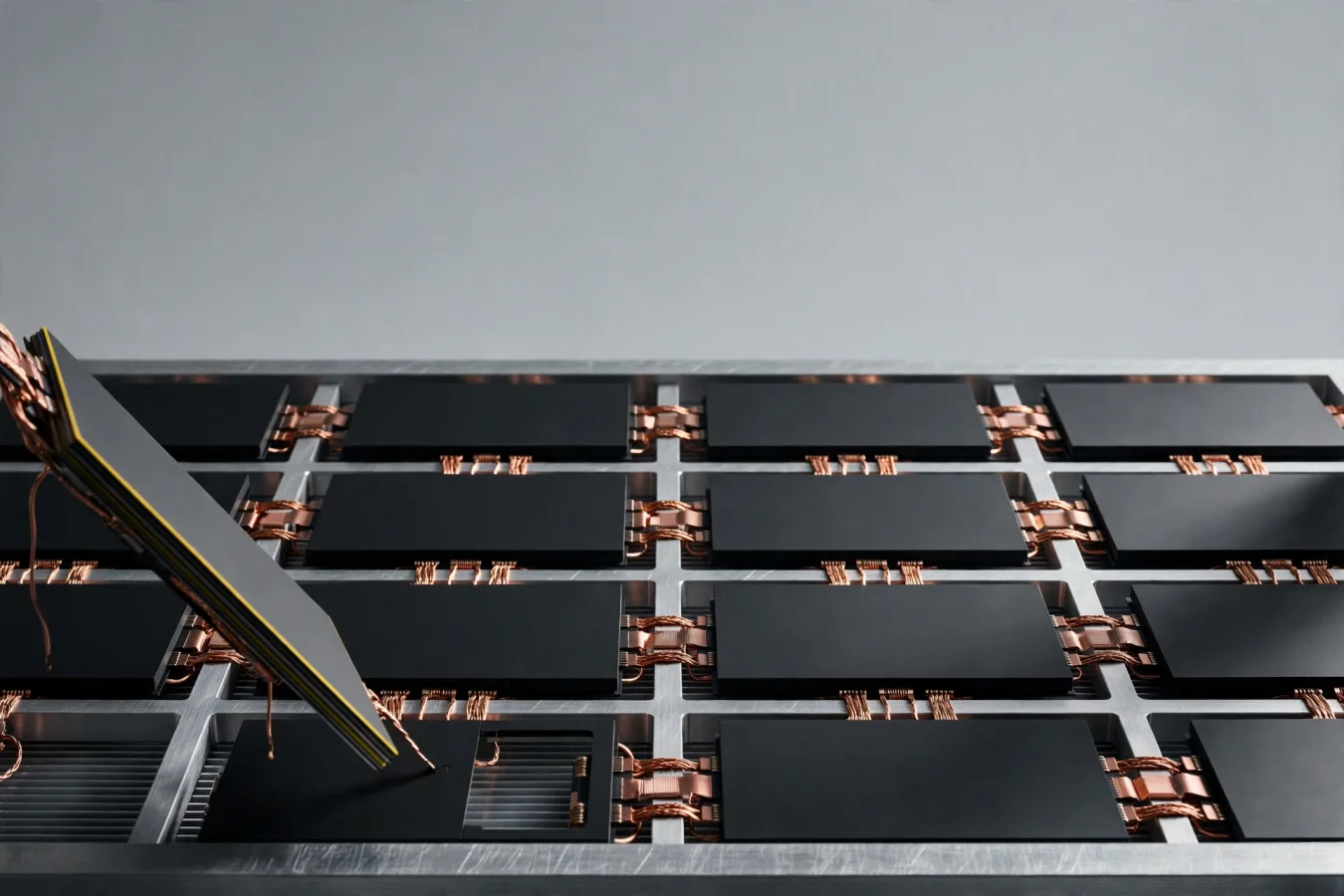
Maia 300 with 288 GB of HBM4: Microsoft's third-generation custom AI chip bets on inference
On Monday, October 12, 2026, Microsoft launched its third-generation in-house AI accelerator, the Maia 300, and said the company could put more than a million chips into operation next year to power its internal AI services. But the headline claim of 40 percent better efficiency is a company promise without named comparison systems and without independent measurements — for now.
The concrete news: a million chips in 2027
The launch was reported by Reuters (Stephen Nellis and Max Cherney), who write that Microsoft plans to put "potentially more than a million of them" into operation next year to support its internal AI services (Reuters via MSN, afbe044e). That is a dramatic jump from its predecessor: the Maia 200, launched in January 2026, was produced in limited runs of only tens of thousands of units according to Cryptobriefing, and The Information reported in August that as of the summer it was running in just two US data centers (MSN report, 94a9dd35).
Deploying more than a million chips within a year would mean a significant increase in volume relative to the predecessor's production levels. It is worth noting that the volume is a plan, not yet a reality: Cryptobriefing reports, citing unresolved research findings, that Microsoft is negotiating with TSMC for production of more than 300,000 Maia 300 chips with delivery in 2027 — negotiations, not signed contracts (Cryptobriefing, c859af1a).
The chip in detail
According to Microsoft's specifications, as reproduced by Notebookcheck, the Maia 300 delivers up to 13.8 PFLOPS of FP4 compute and 6.9 PFLOPS at FP8 precision. SoC power draw is set at 950 watts, up from the predecessor's 750 watts. On the memory side, it is dimensioned for large language models: eight HBM4 stacks provide a combined 288 GB of memory and 18 TB/s of bandwidth (Notebookcheck, 41959191).
The compute silicon itself is built as chiplets — specialized dies bonded together — with TSMC's 2-nanometer process used for the core compute functions, while cheaper 3-nanometer technology covers other functions, Reuters writes (afbe044e).
At the system level, 96 accelerators are placed in a single rack drawing around 167 kW. By comparison, Nvidia's newest GB300 rack, with 72 GPUs, uses 142 kW (afbe044e). The scale-up architecture supports clusters of roughly 12,000 accelerators via two-tier Ethernet (41959191). Note that the Maia option thus draws more power per rack than Nvidia's — it is precisely this starting point that gives meaning to the claim of efficiency per megawatt.
The efficiency claim: a target, not a measurement
Scott Guthrie, executive vice president of Microsoft's cloud group, said according to Cryptobriefing that Microsoft expects the Maia 300 to deliver "40 percent more tokens per megawatt compared to leading GPU-based systems" (Cryptobriefing, c859af1a).
The wording does three things worth flagging. First, the claim is expressed as an expected outcome, not a measurement. Second, the comparison systems are not named; Reuters writes that Microsoft did not specify which systems the company used for comparison (afbe044e). Third, no independent benchmark exists. Notebookcheck's analysis is clear that the company has not provided sufficient detail about the competing GPU configurations for the efficiency advantage to be independently established (41959191).
Microsoft's own explanation points to the gains coming from the whole system, not just the chip. Rani Borkar, president of Azure hardware systems and infrastructure, told Reuters: "It's fundamentally about delivering more intelligence for every watt, every dollar and every byte of memory by optimizing across the entire system" (Reuters via MSN, afbe044e).
The strategy: inference, not training
The Maia 300 is positioned as an inference accelerator. Nvidia's processors still dominate the training market, but Microsoft is betting that its own chips can be a more efficient alternative for running models, particularly as AI agents become more capable and compute-intensive, Ynetnews reports (Ynetnews, 24b122fd).
In a blog post, Guthrie said Maia will become "the primary AI inference system for Microsoft's products and services," and CEO Satya Nadella called the launch "our biggest bet yet on our own silicon" in a post on X, according to the MSN-carried report (MSN report, 94a9dd35). Mustafa Suleyman, head of Microsoft AI, framed the logic to Newsbytes: "We need a platform that we own, and that we co-design with our models" (Newsbytes, bdd30ba4).
At bottom, this is a question of costs and vendor dependence — Reuters frames the launch as driven by an eye on cost savings (afbe044e). A proprietary inference accelerator in million-unit volumes could lower the cost per token on Microsoft's heaviest internal AI workloads. Evercore ISI analysts estimate that Maia will account for around 10 percent of Microsoft's AI chip spending — an analyst estimate, not a company figure (94a9dd35).
This is neither a war nor a break with Nvidia, however. Nadella said at the company's earnings call in July that Microsoft will be among the first cloud providers to deploy the next generation of systems based on Nvidia's Vera Rubin and AMD's Helios (94a9dd35). The custom-chip push is a supplement within what remains a close partnership — and Nvidia is simultaneously the Maia 300's most important benchmark.
Open questions
Three things remain unresolved. First: whether the chip delivers on its promises. No independent benchmarks exist, and the 40 percent claim rests on unnamed comparison systems. Second: whether the volume materializes. The reported TSMC deal for 300,000 chips is still in the negotiation phase, and the jump from tens of thousands to more than a million units in a single year is ambitious by any measure. Third: whether Maia will ever be available to external customers. Microsoft's chips currently cannot be rented by outside parties, and the company has not confirmed any change on that point — although Cryptobriefing reports discussions about possible external customers, without this amounting to signed agreements (c859af1a).
For now, the safest thing that can be said about the Maia 300 is what Microsoft itself said: a big bet, with targets and timelines that cannot be evaluated until 2027.
Sources: Reuters via MSN (afbe044e), Notebookcheck (41959191), Cryptobriefing (c859af1a), MSN report (94a9dd35), Ynetnews (24b122fd), Newsbytes (bdd30ba4).