

Microsoft launches Maia 300: 96 accelerators per rack and rollout starting next year
The company promises multi-gigawatt deployment of its own Maia chips starting next calendar year and claims 40 percent more tokens per watt than leading GPU systems — but the figures are independently unverified, and the Nvidia bill isn't going away.
Microsoft on Monday, October 12, 2026, launched Maia 300, the third generation of the company's own AI chips, with large-scale deployments beginning in 2027. In blog posts from Azure chief Scott Guthrie and CEO Satya Nadella, the Maia family was placed at the center of the company's AI infrastructure: starting next calendar year, it is to scale to multi-gigawatt deployments and become the "primary inference system for our own products and services," Nadella wrote on X, according to Yahoo Finance/Moby (92ce5731).
Guthrie used almost the same formulation in his blog post: Maia is to become "the primary AI inference system for Microsoft's products and services," GeekWire reports via MSN (8de5099b).
What was actually announced
The core of the announcement is twofold: a new chip and a deployment strategy. Maia 300 is designed specifically for inference — that is, running finished models, not training them. Microsoft describes the architecture as rebuilt from the ground up and tailored for memory-intensive reasoning over long contexts and latency-critical agentic tasks, according to HotHardware's review of the announcement (2ea50f38).
The deployment strategy is the strategically most important part. Nadella's formulation about multi-gigawatt deployments means the company plans data center facilities measured in gigawatts in which its own chips make up the bulk of inference capacity. That is an ambition level Microsoft's own chip family is still far from having achieved.
Technical specifications — as the company presents them
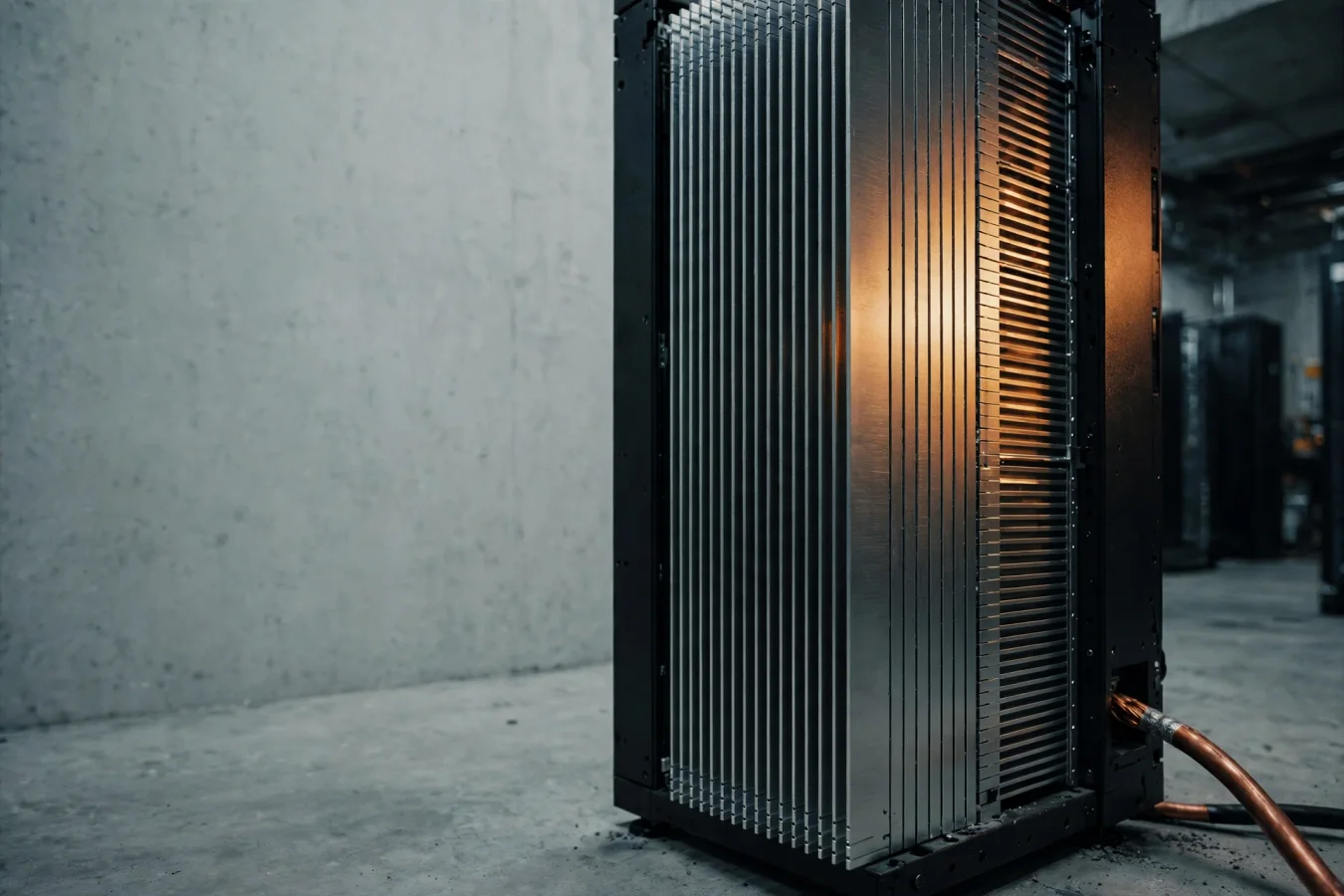
Maia 300 is to be delivered in rack units with 96 accelerators within a power envelope of 167 kilowatts per rack. Total HBM capacity per rack is 27.6 terabytes, with aggregate HBM bandwidth of 1.7 petabytes per second (2ea50f38).
Per chip, Microsoft states eight HBM4 stacks with peak bandwidth of 18.0 TB/s, and a thermal design power (TDP) of 950 watts. The chip uses a modular chiplet architecture separating compute, memory controllers, and I/O. The compute chiplets are manufactured on TSMC's advanced N2P process node, but the company gave no details about the remaining chiplets — a gap in the presentation that HotHardware points out (2ea50f38).
AFP/TechXplore adds that each rack is to hold twice as many chips as before and handle up to seven times the workload, and that the systems are primarily liquid-cooled but can also operate in air-cooled data centers (b9d2dab6).
The efficiency claims — and what they rest on
Nadella's figure is the most aggressive: Maia 300 is to deliver "40 percent more tokens per watt compared to leading GPU-based systems" (92ce5731). Microsoft also claims up to seven times the rack throughput compared with Maia 200. However, the company gave no benchmark methodology or comparison basis for any of the figures, and according to Yahoo Finance, Microsoft did not specify how much better Maia 300 is than Maia 200 in a direct generational comparison.
All of these figures are thus the company's own claims, relayed through secondary sources, and not independently verified.
How far has Microsoft actually come?
The predecessor Maia 200 provides the best basis for assessing credibility. It runs workloads today for Microsoft 365 Copilot, including OpenAI models, the company's own MAI models, and open-source models, and is deployed in the US, Europe, and Australia. Microsoft claims it delivers up to 1.7 times more output per watt than leading GPU systems for AI features in Teams and Copilot (b9d2dab6).
But its footprint is modest: in August, The Information reported that Maia 200 was at that time running in only two US data centers (8de5099b). It is against this baseline that the multi-gigawatt promises should be evaluated.
The tension between rhetoric and the balance sheet
The analyst firm Evercore ISI estimates that Maia will account for around 10 percent of Microsoft's spending on AI chips by early 2027, according to CNBC via GeekWire (8de5099b). At the same time, Microsoft continues to be a major Nvidia customer and is planning early deployments of Nvidia's Vera Rubin and AMD's Helios systems.
That is where the main tension in the story lies: "primary inference system" for its own products does not have to mean a majority of the chip budget, and the timeline for an actual reduction in Nvidia dependence is not established. Microsoft designs the chips and has TSMC manufacture them, rather than buying finished chips from Nvidia (8de5099b) — but the purchase agreements remain.
The reactions
The stock rose more than 1 percent on the news and closed Monday at $541.15, according to Yahoo Finance/Moby — a source that should be treated with caution since the piece has a promotional character (92ce5731).
On X, venture capitalist Chamath Palihapitiya placed Microsoft's move in a broader trend of actors building the entire stack themselves. Elon Musk replied that the enduring bottlenecks lie elsewhere: "Scaling power harnessed, along with super fast construction, cooling, networking and batteries. This is hard" (e8aa9967). The point points toward the other layer of Microsoft's bet: the chip itself is only one constraint among several.
What remains open
Three questions remain. First, there is no documented methodology behind the 40 percent and 7x figures, which so far are only marketing. Second, the non-compute chiplets in the architecture are undocumented. Third, it is unclear when — or whether — Microsoft's own chips will actually reduce its Nvidia dependence, given that the estimate for 2027 is still only 10 percent of the chip budget, and that the company is simultaneously betting on Nvidia's and AMD's next generations. In other words, Maia 300 has to prove itself in practice first in 2027.