


Nvidia Launches AI Data Center in a Shipping Container — Promising Full Operation in 14 Days
At Nvidia's GTC conference in Berlin on October 21, 2026, the company unveiled the DSX Pod — a fully assembled AI data center in container form, with seven Vera Rubin racks, factory-installed cooling, and a promise of operation within 14 days. The product is the centerpiece of Jensen Huang's Europe push, in which he ties deployment speed to the math that a delay costs operators billions.
An AI Factory on a Truck
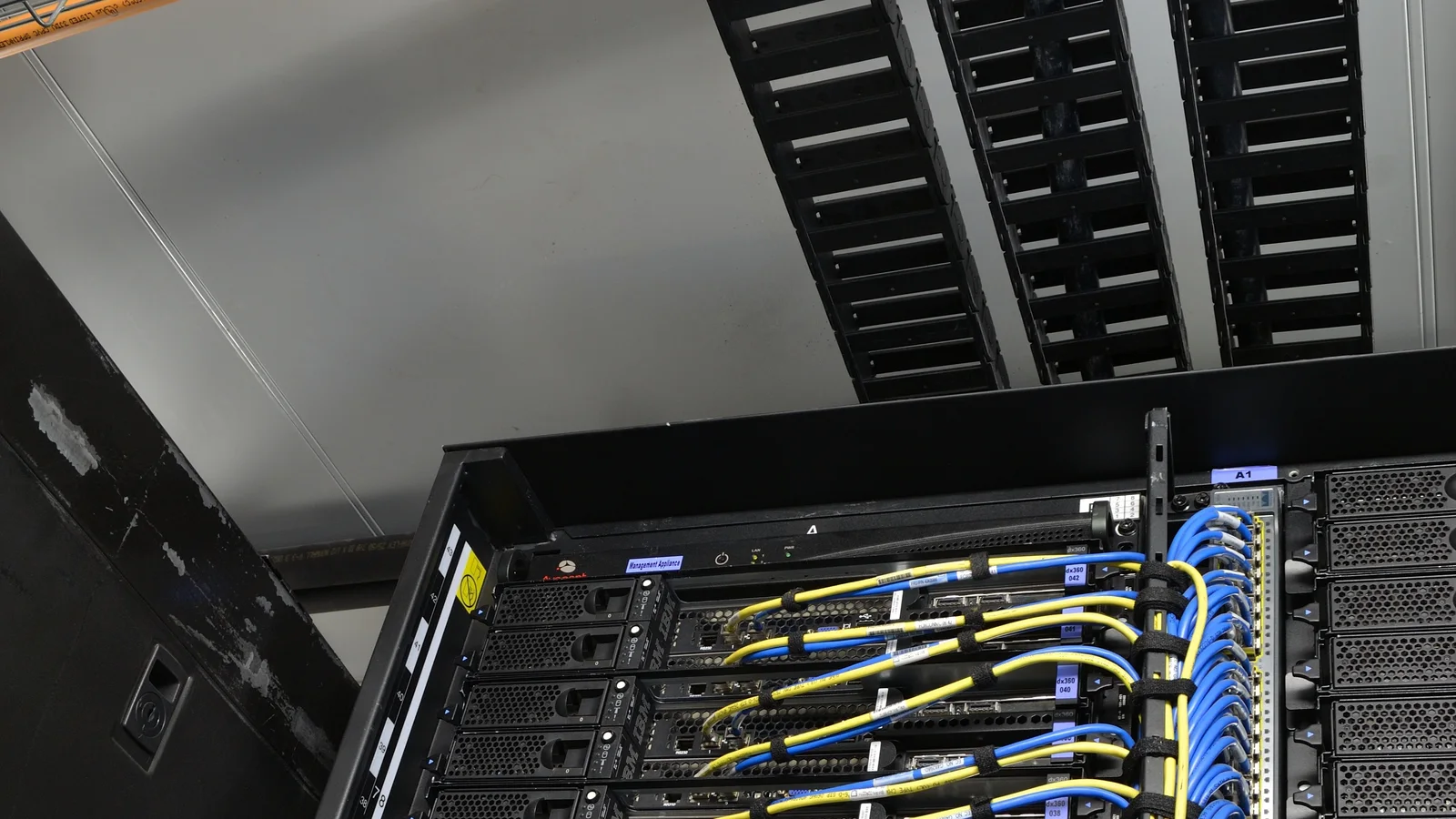
The DSX Pod is roughly the size of a standard shipping container and weighs around 28,000 kilograms, Nvidia said at the launch. The unit is designed to be transported by truck on ordinary roads, and all cabling and liquid cooling is installed at the factory before it ships, according to CNBC.
Inside are seven AI racks of the Vera Rubin type, Nvidia's newest computing platform. Nvidia supplies the reference architecture, while a range of partners will manufacture and deliver the Pod, with first deliveries expected in early 2027.
Ian Buck, Nvidia's vice president for hyperscale computing, explained during a call with journalists what actually remains once the container arrives: "The only thing that needs to happen when it gets to the site is that it's placed where it's supposed to go, connected to the other containers, and validated through final burn-in and testing," he said, according to CNBC.
WIRED, which covered the launch, describes the DSX Pod as Huang's first major announcement from the stage: a "plug-and-play" version of AI data center construction that can be brought online in 14 days rather than the months or years a traditional data center build normally requires. All deployment-time figures come from Nvidia's own presentation and have not been independently verified.
The Economics of Speed
The sales argument is not the technology itself, but the math Huang laid out on stage. An AI factory of one gigawatt costs around $50 billion and can generate roughly $40 billion in annual revenue, he said, according to Stocktwits' coverage via MSN. With those figures, a one-quarter delay — about three months — amounts to roughly $10 billion in lost revenue.
The DSX Pod is meant to cut the time from when equipment arrives on site to when it produces tokens. "We believe something in the range of four to five months, down to about a month," Huang said, according to Stocktwits. Less equipment sitting idle, he argued, means "the wasted idle compute capacity, the wasted idle capital equipment will be reduced, and everyone becomes more profitable."
Nvidia has not disclosed a price for the DSX Pod. CNBC reports that analysts estimate a single Vera Rubin rack could cost more than $7 million — an indication of the order of magnitude for a seven-rack system, but an estimate from unnamed analysts, not an official price. Stocktwits reported in its coverage that Nvidia's stock rose around 2 percent in the run-up on launch day.
Europe's Shortfall and Huang's Message
The context for the launch is Europe's underrepresentation in global AI computing capacity. Europe accounts for roughly 5 percent of the world's AI computing power, compared with 75 percent in the United States, according to Associated Press via Newsday. Building out data centers is therefore the key for the continent, was the message.
At the same time, Huang claimed Nvidia has invested $10 billion in European startups and partners over the past year — a company figure that has not been independently confirmed in the coverage.
The message to European politicians was barely veiled. The day before the keynote, Huang told German Chancellor Friedrich Merz that Europe cannot regulate its way to technological leadership. "There is nothing to regulate if the industry doesn't thrive," Huang said to Merz, according to Business Insider.
Partners and Production
According to Stocktwits, Nvidia supplies the reference architecture, while a broad group of technology and infrastructure companies will build and deliver the Pod: Dell Technologies, Hewlett Packard Enterprise, Lenovo, Vertiv, Schneider Electric, Eaton, Pegatron, Wistron, Foxconn, Crusoe, and DayOne. CNBC additionally names Gigabyte and Quanta among the manufacturing partners, with deliveries from early 2027.
The model resembles what Nvidia already does at the rack level — fully assembled, tested units that reduce work on the customer's site — but scaled to the container level. By moving cabling, cooling plumbing, and integration from the construction site to the factory, both the time and the risk in the project shift. This is what Huang points to when he calculates lost revenue per delayed quarter: the critical path in an AI data center project often lies in integration and commissioning, not in the building itself.
The Rest of the Europe Vision
The DSX Pod was not alone on stage. Huang launched an entire stack aimed at Europe, according to WIRED and AP:
- Humanoid robots as "the next great industry." Huang argued that Europe, with its manufacturing history, is well positioned to lead here. Nvidia showed off a full-stack robotics platform and a preconfigured reference robot, Agile One, which is to be available in the first quarter of next year.
- Autonomous driving. Nvidia announced partnerships with Volkswagen and Mercedes, according to AP and WIRED.
- OpenShell. To address concerns about AI agent safety, Huang presented OpenShell, open-source software designed to exercise external control over what AI applications do and to block them if they violate a company's policies, according to AP. It is an attempt to give companies — and perhaps regulators — a tool instead of just a promise.
What Remains to Be Proven
Between the presentation and reality lie several open questions.
First, all the key figures — 14-day deployment, $50 billion per gigawatt, $40 billion in annual revenue, $10 billion in European investments — are Nvidia's own claims from the stage, as relayed by journalists. No primary sources from Nvidia with specifications or documentation appear in the coverage, and the claims have not been independently verified.
Second, the price is unknown. The analysts' estimate of more than $7 million per rack makes it reasonable to assume that a full Pod with seven racks costs a significant sum, but Nvidia has not announced any figure, and extrapolating further would be speculation.
Third — and most important for the Europe narrative itself — containerized computing power does not necessarily solve the bottlenecks that actually limit European buildout: access to power, grid connections, and site preparation. A DSX Pod arriving by truck still has to be connected to power and cooling at scale, and none of the sources quantify whether Europe's power availability keeps pace with such deliveries. Huang's math concerns the time from equipment arriving to tokens being produced — not the time it takes to secure power and land.
It also remains to be seen whether deliveries actually begin in early 2027, and who the European customers will be. No European orders have been announced in the coverage. Until then, the DSX Pod is a promise of speed, packaged in steel and shipped by truck — and a message from Huang to Europe that time, not technology, is the most expensive thing.