


Nvidia's AI factories are promised in 14 days — but only where power and cooling are already in place
The company launched DSX POD at GTC Berlin: complete Vera Rubin data centers built in modular containers, ready to plug in. But the 14-day clock only measures the easiest part of the build — land acquisition, permits and grid connection fall outside the equation.
Nvidia launched DSX POD on October 21, 2026, a reference design for complete "AI factories" based on the company's Vera Rubin platform, built by partners inside modular containers and integrated and validated before delivery. According to Nvidia's press release, the units are to arrive on site ready to connect to power, cooling, networking and other supporting infrastructure — cutting deployment time from six months to as little as 14 days [847a858a].
The figure, however, is a manufacturer's claim, and it applies only to a narrow slice of the build. And the message landed in an atmosphere where there was already resistance in the room: During Huang's keynote, two Greenpeace activists raised a banner reading "Clean up your dirty business," according to WIRED's reporting from the scene [17e1d27c].
What DSX POD actually is
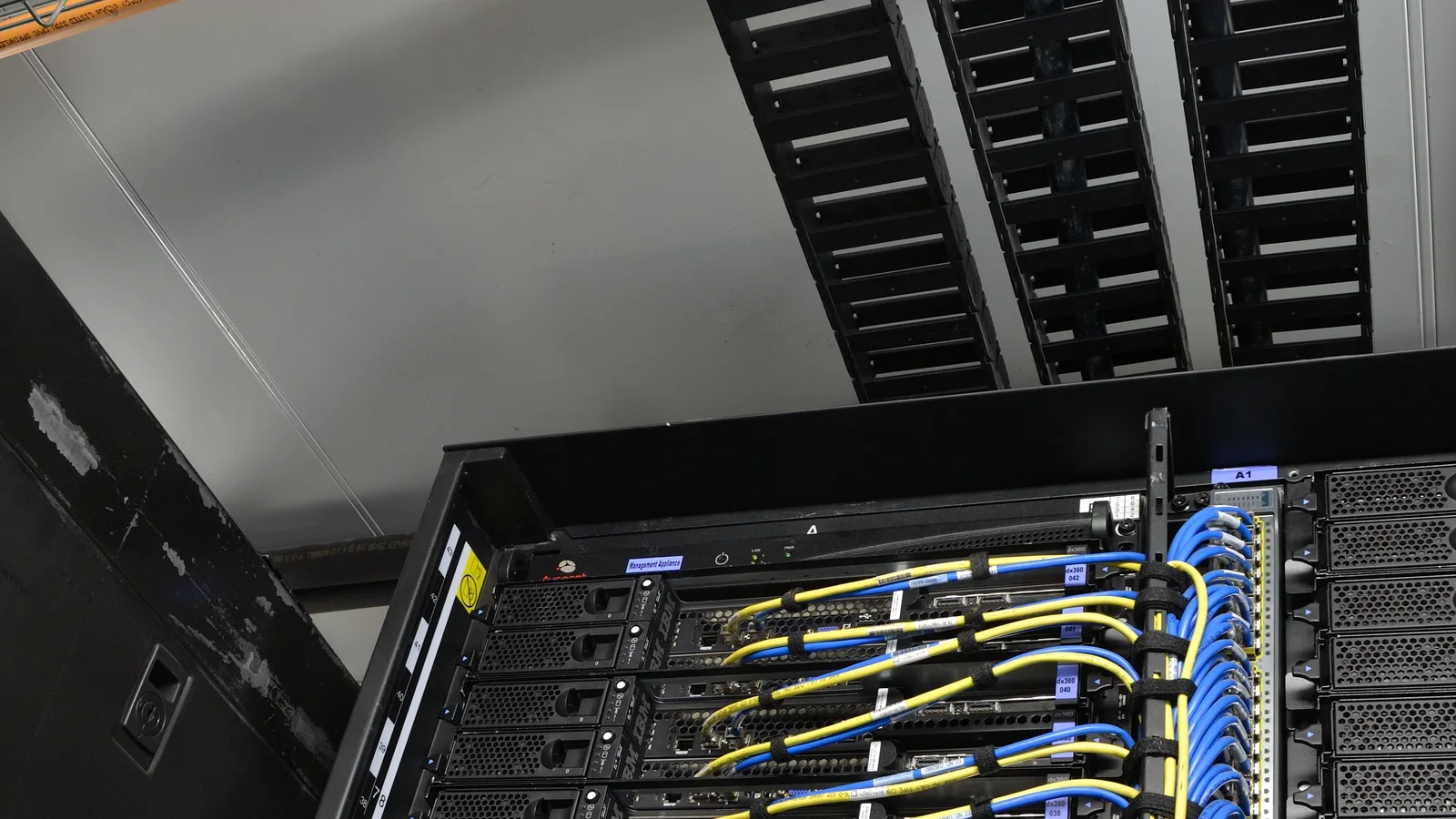
DSX POD is not a product Nvidia builds itself, but a reference design: a recipe partners follow when constructing complete AI data centers in large metal containers. Everything arrives pre-assembled, with Nvidia's newest Vera Rubin compute racks packed inside, WIRED describes from the keynote [17e1d27c]. Jensen Huang, Nvidia's founder and chief executive, framed it as a "plug-and-play" option for building AI data centers — online in 14 days instead of months or years of construction [17e1d27c].
According to secondary coverage at Gadget Review, each pod consists of seven Vera Rubin NVL72 racks, 504 GPUs and 252 Vera CPUs, as a single integrated unit weighing around 28 tons [b1714f52]. This figure deserves a cautious read: the specification comes from secondary reporting and is not confirmed against the press release itself in the source material, so it should be treated as unconfirmed until Nvidia verifies it.
The math — and what it doesn't cover
Nvidia's claim of "from six months to as little as 14 days" is worth taking seriously, but also placing precisely. Gadget Review's analysis of the launch notes that the 14-day figure assumes a site that already has power, cooling, networking and civil infrastructure in place [b1714f52]. All the hard parts — land acquisition, permits, construction of a substation, and the actual grid connection — therefore lie outside the clock Nvidia starts.
That doesn't mean the product is useless. It means it moves the bottleneck: the time-consuming subtask of integrating and validating a complete data center on site is moved to the factory, which is real and valuable. But for anyone weighing how quickly an AI factory can actually come online, the real constraints are power availability and grid connection — issues no container design can solve alone. Huang himself framed the point in the press release: "An AI factory creates value when it starts producing tokens — not when construction is complete," he said [847a858a] — a phrasing that indirectly concedes the value lies in the time after construction, not in the construction process itself.
The market and ecosystem around it
Nvidia lists a long roster of partners: Anduril, Armada, Bull, Crusoe, DayOne, Dell Technologies, Delta, Eaton, Foxconn (Ingrasys), GIGABYTE, HPE, Lenovo, Pegatron, Quanta Cloud Technology, Schneider Electric, Vertiv and Wistron are to deliver DSX POD AI factories worldwide in early 2027 [847a858a]. The list spans a wide range: traditional data center integrators and power and cooling specialists (Schneider Electric, Vertiv, Delta, Eaton), PC and server makers (Dell, HPE, Lenovo, Foxconn, Wistron), and more unconventional players such as the defense and drone technology company Anduril and the edge computing company Armada.
The stock market received the news positively: Nvidia's share price rose on the launch, Investor's Business Daily reports [33ca0882]. Seeking Alpha framed the launch the same way as the press release — a reference design that reduces on-site work, with units ready to connect to power, cooling and networking [04e58703].
The environmental claims — and the context they landed in
Nvidia also claims DSX POD is an environmentally friendlier option. According to MSN's coverage, the system supports liquid cooling and uses dry-cooler designs that can save up to 54 million liters of water per day compared with a standard data center [2be0e95f]. This is a manufacturer estimate without independent verification, and it is measured against an undefined "standard data center" — meaning its accuracy is impossible to assess from what is available.
The claim landed in a particular context. During the keynote, where Huang pitched to a European audience, two Greenpeace activists disrupted the speech with the banner. Huang, according to WIRED, told his security team to "go easy" as the activists were escorted out [17e1d27c]. The tensions in Europe — where data center construction faces resistance tied to power consumption, water use and local opposition — make the environmental claims a central part of the sales test ahead.
What remains open
DSX POD is an announced product, not a delivered one. Shipments begin at the earliest in early 2027, and there are so far no real deployments that can verify either the 14-day figure, the water savings, or the claim that the pods will actually perform as promised in practice. Maintenance of a sealed, factory-integrated unit — what happens when one of 504 GPUs fails? — is an open practical question none of the sources answer. And the pod specification (seven NVL72 racks, 504 GPUs, 28 tons) should be treated as unconfirmed until Nvidia itself verifies it.
What is well documented, however, is the direction: Nvidia is attempting to move AI infrastructure construction from the construction site to the factory, and to build an ecosystem of partners that can deliver complete data centers as modules. Whether that actually shortens the path to a working AI factory in practice — or merely moves the friction from the machine hall to the building permit — remains to be seen.
Early 2027 is promised as the answer.