

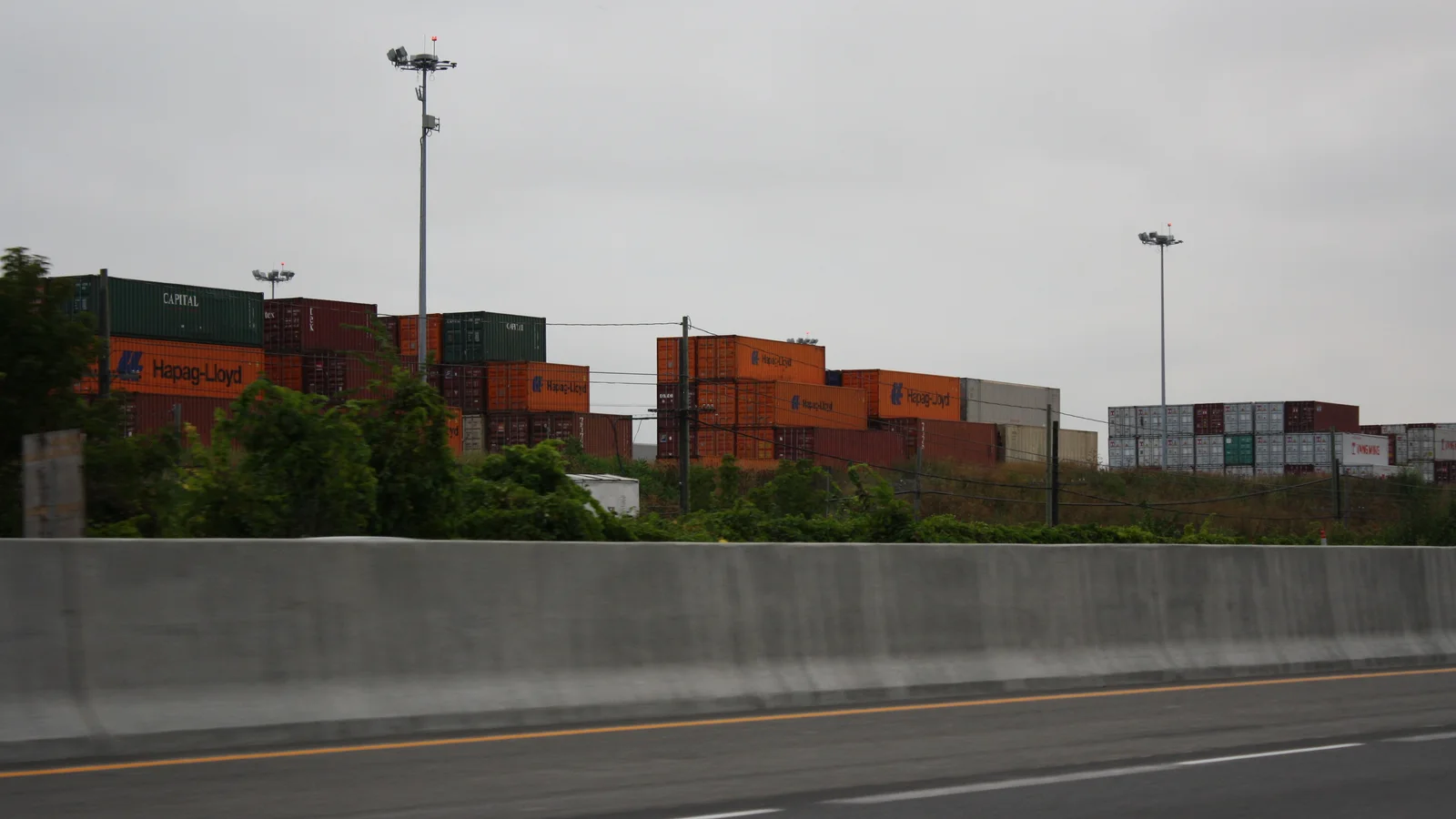

NVIDIA's DSX POD: an AI data center in a container — claimed to be operational in 14 days
Jensen Huang opened NVIDIA's GTC conference in Berlin with something bigger than a new chip: a factory-assembled "AI factory" in a container, packed with Vera Rubin racks. But the 14-day clock only starts at a site that already has power, cooling, networking, and civil infrastructure — and the vendor's figures are not yet independently verified.
Jensen Huang launched the DSX Pod at NVIDIA's GTC in Berlin on Wednesday, October 21, 2026: a modular "AI factory" that arrives fully assembled in a large metal container, packed with the company's newest Vera Rubin compute racks. According to NVIDIA, the unit can be brought online within 14 days of delivery, versus roughly six months for a traditional build-out — figures that all come from the company itself, relayed through press coverage of the event (WIRED, Yahoo Finance). First deliveries are, according to the company, planned for early 2027.
What the DSX POD actually is
The DSX POD is a containerized computing unit delivered "plug-and-play" ready: according to NVIDIA, the Vera Rubin-powered PODs arrive at the site ready to be connected to power, cooling, and network infrastructure (Yahoo Finance). The idea is that the heavy integration work — compute, power distribution, cooling, and networking — is done at the factory, so that on-site work is reduced to hooking up and starting up.
Detailed specifications are still lacking from NVIDIA itself. Secondary reporting on the announcement, cited by Yahoo Tech, describes a configuration of seven Vera Rubin NVL72 racks — around 504 GPUs and 252 Vera CPUs — as a single integrated unit weighing approximately 28 metric tons (Yahoo Tech). But these figures are not confirmed in any official NVIDIA datasheet and should be read as reported — not verified — specifications.
At the same time, NVIDIA emphasizes that the DSX POD is not meant to replace traditional data centers, but to serve as an interim play: a way to get AI applications running before permanent buildings are ready (Yahoo Finance).
Where the 14-day clock starts — and stops
The most important caveat in the entire announcement is easy to miss: the 14-day figure explicitly applies only to a site that already has power, cooling, networking, and civil infrastructure in place (Yahoo Tech). Everything that in practice takes longest in European projects — permits, transformer substations, fiber, and grid connection — falls outside the clock and is not quantified anywhere in the available sources.
That means the real timeline for a project, from greenfield to operating AI capacity, can still be measured in months or years. What the DSX POD actually eliminates is the construction time of the data center structure itself — not the build-out process around it.
The partner ecosystem — and an unresolved question of numbers
NVIDIA says the DSX POD will be delivered from early 2027 through a broad ecosystem of partners (Yahoo Finance). But there is a discrepancy in the sources: one report (MSN/Chosun Ilbo) cites 17 partners, including Dell Technologies, HPE, Lenovo, Foxconn, and Vertiv, covering servers, power, and cooling (MSN/Chosun Ilbo). Another source (Yahoo Tech) lists a longer roster of names — also including Schneider Electric, Eaton, Gigabyte, Quanta Cloud Technology, Wistron, Crusoe, Armada, Anduril, Bull, DayOne, Delta, and Pegatron, "among others." The exact partner list has not been established.
The roster of names nonetheless says something about the strategy: NVIDIA is pulling in server makers (Dell, HPE, Lenovo, Foxconn), power and cooling specialists (Vertiv, Schneider Electric, Eaton, Delta), and less conventional players such as the defense and edge companies Anduril and Armada.
The business logic: tokens, not construction projects
Huang himself tied rapid deployment directly to earnings: "The value of an AI factory (data center) lies not in when construction is completed, but in when it begins producing tokens," according to MSN/Chosun Ilbo. The argument is that every month a center sits idle is lost revenue — and that coming online six months earlier therefore has direct financial value. In a statement quoted by Yahoo Finance, Huang said the DSX POD brings "factory-built precision and speed to AI infrastructure construction — cutting deployment time from months to weeks, so customers can scale capacity and get revenue-generating production up and running faster."
The same report cites a Morgan Stanley estimate of approximately $7.8 million per NVL72 rack, which assembles 72 NVIDIA GPUs and 36 CPUs — a figure that is the bank's estimate, not an official NVIDIA price. With seven such racks per POD, that would — if the estimate holds — mean a significant investment per container, but no source states a price or commercial terms for the DSX POD as a product.
The cooling system is another part of the sales pitch: according to NVIDIA, the DSX POD uses liquid cooling with a dry-cooler design, which is claimed to save up to 54 million liters of water per day compared with a standard data center (Yahoo Finance). This is a vendor estimate that varies with climate, workload, and site configuration, and which no independent source has confirmed.
The European context
The keynote positioned modular data centers as one of three pillars in Huang's vision for Europe, alongside robotics and AI agents (WIRED). The message was explicit: Europe is lagging on AI infrastructure, and plug-in data centers are to be a way to close the gap faster. Industry observers quoted by MSN/Chosun Ilbo also read the announcement strategically: NVIDIA is moving beyond selling chips, toward shaping how the data centers themselves are designed and standardized.
What remains to be answered
Several questions remain open. There is no primary NVIDIA documentation in the available record — all key figures (14 days, the six-month baseline, the water savings, the weight, the GPU count, the partner list) come via secondary coverage of the company's statements. Performance, power efficiency, and serviceability cannot be assessed until the production systems are actually delivered, with a target of early 2027 (Yahoo Tech). And the biggest unanswered question — how long a full build-out actually takes once permitting and grid connection are counted — is not quantified anywhere.