

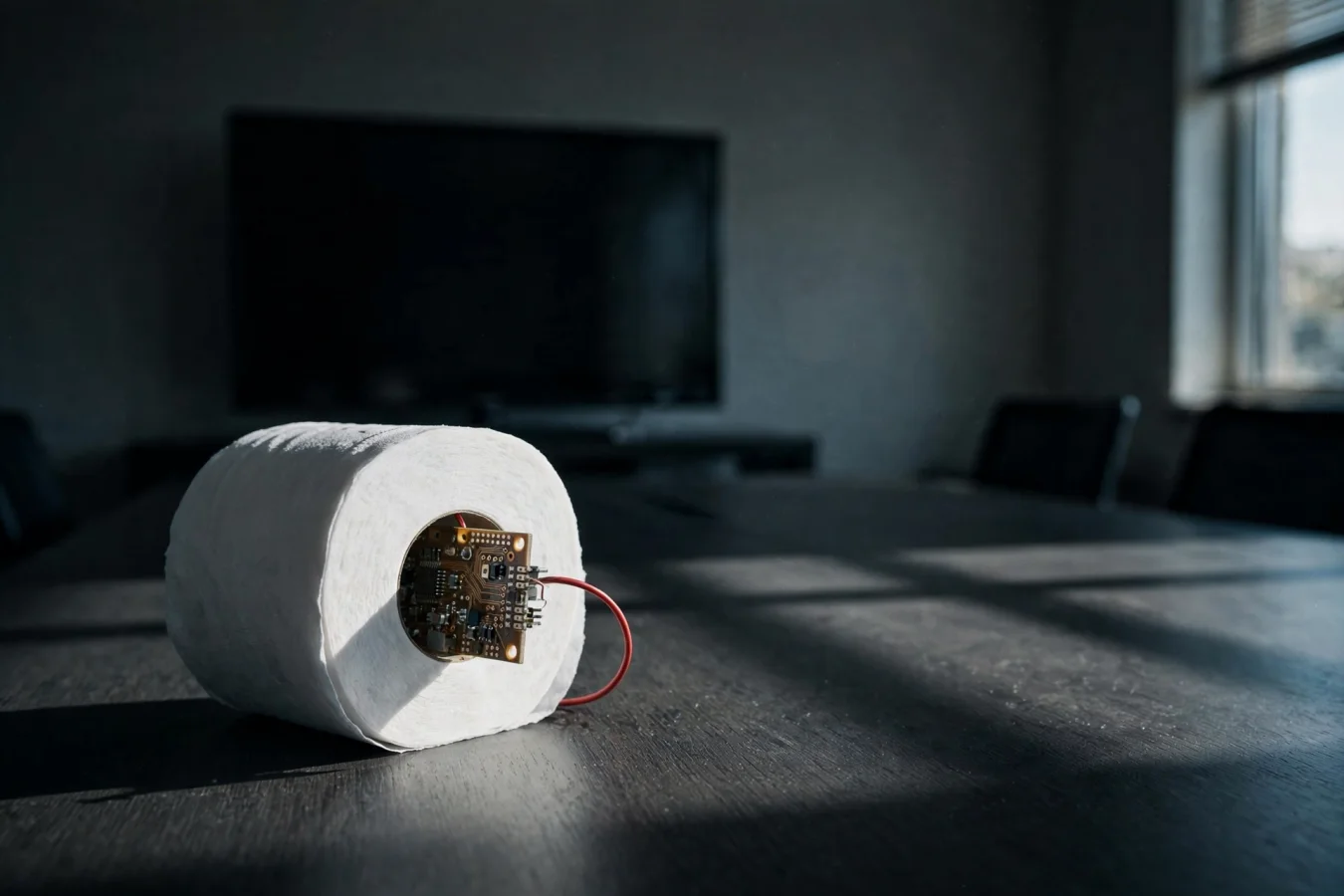
FBI: OpenAI engineer allegedly planted board worth $13.99 that eavesdropped on conference room
A thumb-sized development board costing $13.99, hidden inside toilet paper behind a TV: that is the core of the federal case against Abdulrahman Alfozan, which the Justice Department announced on Tuesday, October 13. The company claims its own AI models exposed him — but the motive and the contents of the encrypted microSD card remain unknown, and all charges are unproven.
The Justice Department announced on Tuesday, October 13, that the FBI had arrested Abdulrahman Alfozan, a 35-year-old Saudi citizen and OpenAI engineer, suspected of installing hidden audio recording equipment in the company's executive conference room. Alfozan was arrested on Friday, October 9, made his first appearance in federal court on Tuesday, and his next hearing is scheduled for October 19. The case is at an early stage: the allegations in the FBI complaint are unproven, and the investigation is ongoing.
What Alfozan Is Charged With
Alfozan is charged with using or attempting to use "an electronic, mechanical, or other device to intercept oral communication," according to SFGate. If convicted, he faces up to five years in prison, a $250,000 fine, and three years of supervised release, according to the Justice Department, as cited by The Straits Times.
According to the Justice Department, Alfozan has been an engineer at OpenAI since July 2025 and a US permanent resident since September 2020. (SFGate lists August 2025 as his hiring date; the Justice Department's figure is July 2025.) It is unclear whether he has legal representation, and the Saudi embassy did not respond to Reuters' inquiries, according to NBC News.
The Device: $13.99 and a Roll of Toilet Paper
According to the FBI complaint, the device was hidden in toilet paper behind a TV in the conference room and connected to the TV's USB port. In court documents, it is identified as a Seeed XIAO ESP32-S3 Sense — a thumb-sized development board with a digital microphone, a detachable camera sensor, and microSD storage, sold for around $13.99 on the manufacturer's website, according to BigGo Finance, which cites the court documents.
The timeline in the complaint reads as follows: The device was allegedly installed "around September 28" and discovered "around September 30," according to the Justice Department. The data on the microSD card was encrypted — OpenAI's security personnel attempted to export it but could not review the contents. Later, investigators allegedly found a similar, modified device in Alfozan's personal luggage, according to the complaint as cited by the Straits Times.
The Surveillance That Caught Him
The FBI alleges that in the days before September 28, Alfozan used a productivity tool to look up OpenAI's meeting rooms, executives' locations, and partner meetings, according to SFGate. The agency also alleges that an account linked to Alfozan's spouse asked a chatbot how to build a "continuous audio recorder."
After the device was discovered, OpenAI, according to the FBI, installed a camera in the room. That camera, according to the agency, captured Alfozan on October 5 entering the room and apparently checking behind the TV where the recorder was hidden — the same day another similar device was allegedly found in luggage he had left unattended, according to NBC News.
OpenAI's Account — and What the Company Claims
In a statement on X, OpenAI writes that the company took "gradual measures to limit the risk while the investigation was ongoing," including restricted access and leave, before the employment relationship was terminated on Friday, according to NBC News. The company says it has evidence that the employee "intended to deploy additional recording devices."
The company further claims that its internal AI models helped identify who planted the device and trace its origins. This is a company claim: OpenAI has not disclosed how this allegedly happened, and the claim is independently unverified.
In the X post, the company writes: "We take the protection of our technology, data, and our people seriously, and as a matter of national importance. Our security program is designed to protect against a broad range of threat actors, from insider risk to cybercriminals to nation-states, and this case is an example of how AI can help address these sophisticated security threats," according to SFGate.
OpenAI also states that, at this time, it has no indications that the individual "improperly accessed or exfiltrated model weights, source code, or customer data," according to NBC News.
What the FBI Director Says
FBI Director Kash Patel said that Alfozan "allegedly concealed a covert recording device in his employer's executive conference room to secretly capture sensitive communications about the company's superintelligence technology," according to NBC News. That is thus attributed to Patel as an assertion, not a proven account of motive.
What Remains Unknown
Several key questions are unanswered. The motive is not known — neither prosecutors nor OpenAI has offered any explanation for why Alfozan allegedly did this, or what he would have used any recordings for. The contents of the encrypted microSD card are unanalyzed, so it is unclear whether the device captured anything at all. It has also not been confirmed whether Alfozan has an attorney. The FBI investigation is ongoing, and the next court date is October 19 — until then, all charges remain mere allegations from the complaint.