

Former OpenAI Engineer Charged With Bugging Executive Conference Room
The federal complaint against Abdulrahman Alfozan, filed in the Northern District of California, describes a hidden recorder in an executive conference room, chat logs said to tie him to building it, and a company that says it used its own AI models in the investigation. All of it remains allegations.
Abdulrahman Alfozan, 35, a Saudi citizen and US permanent resident since 2020, was arrested on October 9, 2026, and made his first federal court appearance on October 13. He is charged with using or attempting to use a surveillance tool to intercept oral communications. The case is filed in the Northern District of California, and the Justice Department announced the arrest after the complaint was unsealed this week. A detention hearing is set for October 19.
Alfozan joined OpenAI in July 2025. According to prosecutors, he did not participate in the meetings held in the room and did not have access to it.
The alleged device
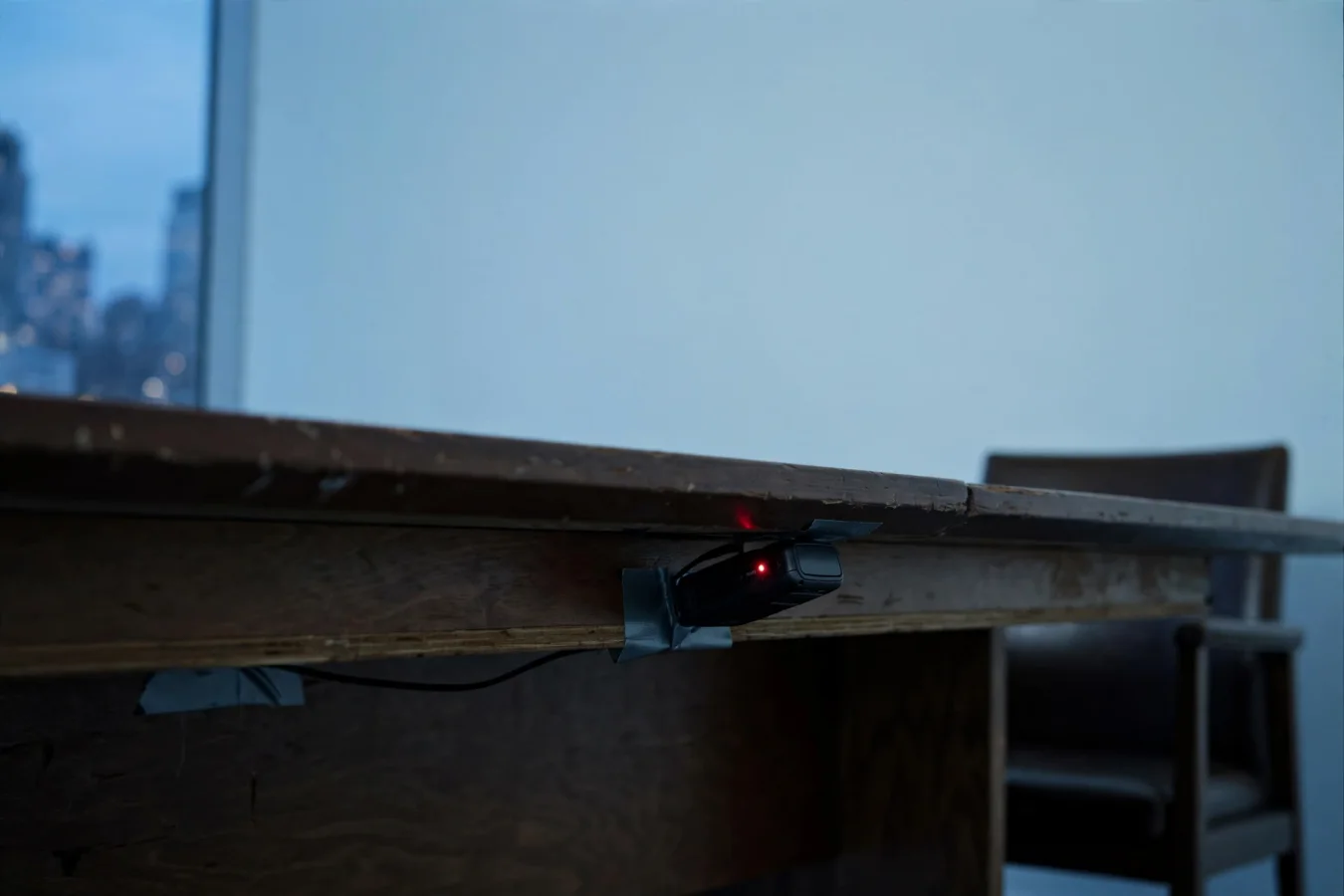
According to the complaint, Alfozan installed the device around September 28, connected via a USB port on the back of a television in a conference room used for highly confidential discussions — the company's own research, product plans and technical information. It was hidden in toilet paper.
In a sworn statement from FBI special agent Lydia Liang, cited by Ars Technica, the device is described as a Seeed XIAO ESP32-S3 Sense development board — a chip-sized board with a detachable camera sensor, digital microphone and microSD storage. Liang writes that the device "had been customized to obfuscate anything stored on the device, such as potentially intercepted audio communications," and that the microSD card had "a layout consistent with a potentially encrypted file system."
OpenAI employees discovered the device on or around September 30.
How the investigation was built
The evidence chain, as prosecutors present it, is chronological and partly digital:
- August: Alfozan allegedly used a productivity agent at OpenAI to find out where and when sensitive meetings were held, according to Liang's statement. He is also said to have used the tool to query building addresses, meeting rooms, calendars and locations labeled "leadership and exec."
- September 24–30: A chatbot account associated with Alfozan's spouse allegedly submitted requests about building, installing, testing and hiding a device with remote access. Between September 27 and 28, the same account is said to have asked specifically about the first recorder, including its custom header and unique MAC address.
- September 30: The device is discovered.
- October 5: OpenAI installs a camera in the room. According to prosecutors, surveillance footage showed Alfozan near the conference room. The same day, security staff found an unattended bag containing his wallet, his credentials and a second similar recorder.
- Afterwards: OpenAI gradually removed Alfozan from its systems while working with the FBI to analyze the device's contents. According to Ars Technica, he was fired at the same time as the FBI arrest on Friday, October 9.
OpenAI's role — and the company's own statements
The case has a distinctive feature: OpenAI itself says it used its own AI models to help analyze the device and identify who had placed it. According to the company, the internal findings fed into a broader investigation that law enforcement eventually took over. The company has not released details of how the models were used.
OpenAI further says it has found no indication that model weights, source code or customer data were accessed or removed without authorization, and that the case was referred to the FBI. The company also claims, according to CNET, that it has evidence Alfozan planned additional eavesdropping devices. All of these statements are the company's own and have not been independently verified or proven in court.
The government's framing
FBI Director Kash Patel tied the case to competition over advanced AI. "Alfozan is alleged to have hidden a secret recording device in his employer's executive conference room to secretly capture sensitive communications about the company's super intelligence technology," Patel said, according to Yahoo News. The quote is translated from English; in the original, Patel is describing an allegation, not established fact.
The national security framing is echoed by others: senior officials, including intelligence chief Jay Clayton, have publicly portrayed the arrest as a national security matter tied to the global race for AI superiority, according to The Briefing/MSN. The Justice Department's National Security Division, with its counterintelligence unit, is assisting in the prosecution, according to a DOJ press release cited by the Daily Caller News Foundation.
None of these characterizations establishes anything about foreign direction or motive. As far as the available information shows, the complaint contains an eavesdropping charge, not an espionage charge.
What is at stake
If convicted, Alfozan faces up to five years in prison, a $250,000 fine and three years of supervised release, according to prosecutors. The detention hearing on October 19 will determine whether he remains in custody going forward.
The case is still at an early stage. Everything presented so far — from the contents of the microSD card to the chatbot logs and surveillance footage — comes from the complaint and Liang's statement, that is, from the prosecution's own account. No conviction exists, and no motive or link to foreign interests has been established. The precise statute underlying the charge should be confirmed against the court filings themselves, as various outlets have reported it somewhat differently — some as use of a surveillance tool, others as use of an electronic or mechanical device to intercept oral communications.
What is safe to say so far is this: a 35-year-old engineer working inside one of the world's most prominent AI companies allegedly placed an apparently encrypted recorder in the room where the company's most sensitive conversations took place — and it was the company's own tools, its own models and a camera installed after the discovery that allegedly led to him.