

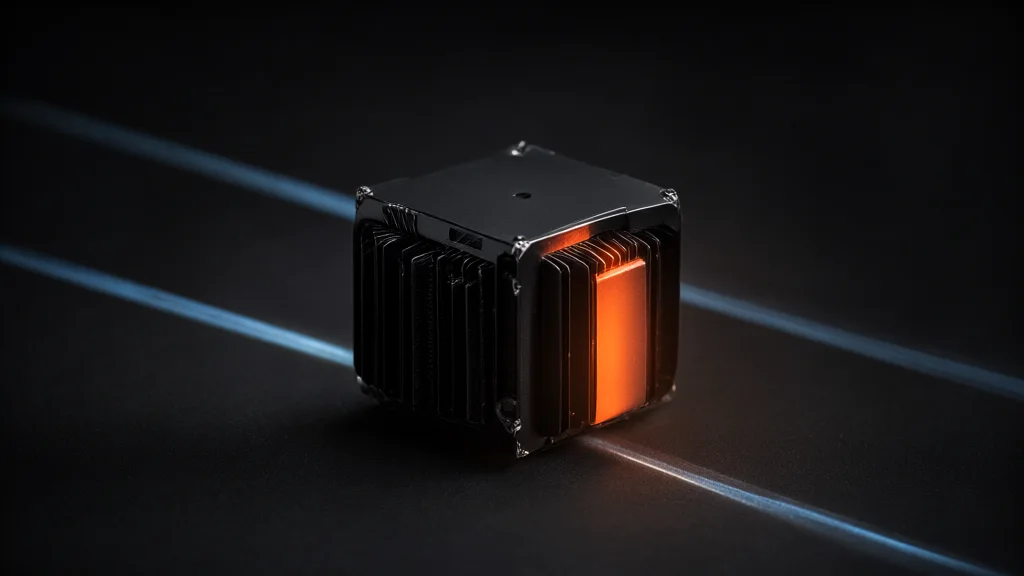
Google's first TPU satellite lifts off October 1 — but cooling limits operations to 15 minutes
The MVP satellite, built by Planet Labs with Google's AI chips on board, will be lofted on a SpaceX Falcon 9 from Vandenberg — but the company itself is tempering expectations: nothing "usefully operational" is expected in the years ahead.
On October 1, Google's most ambitious space experiment to date goes from the lab to orbit. The satellite, which Google has named MVP, will be loaded onto a SpaceX Falcon 9 at Vandenberg Space Force Base in California and launched into low Earth orbit, according to The New York Times, which has been given an exclusive behind-the-scenes look at the project. The mission is part of SpaceX's Transporter-18 rideshare, in which the Falcon 9 carries many payloads at once (Cryptopolitan).
What is being lifted is not an operational data center in space, but the first test step in Project Suncatcher, a research project Google announced in November 2025 (Cryptopolitan): an attempt to find out whether AI chips can work in orbit at all.
What is actually on board
Google did not build the satellite itself. The spacecraft comes from satellite imagery company Planet Labs, while the hardware inside is Google's own — four TPU accelerators, according to Ars Technica, citing the Times' reporting (Ars Technica).
Ahead of the launch, the satellite has passed one central test: the vibration test, in which the company says it shook the satellite on all three axes to simulate launch conditions. MVP came through the test with its screws in place and chips intact (NYT). Google's senior vice president for research, James Manyika, called the results "great" — but said he still wondered what would happen when the satellite reached space.
The power budget is far more modest than in modern data centers on Earth. MVP's solar panels generate about one kilowatt — roughly what a hair dryer draws (Ars Technica).
The chips' toughest adversary: heat
The most limiting factor is not power, but cooling. In space there is no air to carry heat away — everything must be radiated into space via radiators, which takes time. Google will run Gemini models on the TPUs as part of the testing, but not continuously: the cooling system can only keep the chips running in short sessions of about 15 minutes, with thermal interface material connected to aluminum and copper heat pipes that carry heat to the radiator. After that, the TPUs must be switched off so the radiators can recover (Ars Technica).
That means the satellite's actual computing capacity, measured over a day, is only a fraction of what the chips would deliver continuously on Earth. This is precisely why it is a test mission: the goal is to gather data on how the chips behave in the thermal and radiation-rich environment of orbit, not to deliver services.
Google's own claims — and what is independently verified
Several of the key technical claims come from Google itself and have not yet been independently confirmed. In a blog post on September 24, the company wrote that satellites in low Earth orbit receive "nearly constant sunlight," and can therefore generate up to eight times more solar power than panels on the ground (People). This calculation is the entire economic rationale for data centers in space — and it stands in stark contrast to MVP's rigid 15-minute sessions and one kilowatt in practice.
Google also states that TPU chips of the Trillium generation, according to the company's own radiation tests, can withstand a total ionizing radiation dose greater than they would receive over a five-year space mission, and that chips exposed to a proton beam in testing survived (Cryptopolitan). These are, for now, the company's own figures, not independently verified.
How long MVP will operate in orbit is unresolved in the coverage: Ars Technica writes that the satellite will function for only a few months, while Il Sole 24 ORE states it will remain in orbit for six years but be operational for one year, answering simple AI requests from Earth before returning to the atmosphere (Ars Technica; Il Sole 24 ORE).
The roadmap: two satellites, then 80 in formation
If the first test succeeds, Google plans to launch a pair of similar but interconnected satellites in 2027. The premise is laser links between the satellites that must deliver very high bandwidth over very short distances — a level of precision Google itself compares to hitting a coin-sized target several kilometers away (People). Further out is the idea of fleets of 80 satellites flying in tight formation as space-based data centers (Il Sole 24 ORE).
But Google itself has set very low expectations for now. Manyika said the company does not, frankly, expect to achieve anything "usefully operational" within the next few years. He drew the parallel to Google's work on self-driving cars (People).
What a successful test would prove — and what it would not
Even if everything goes as planned on October 1, MVP will only answer the first and simplest question: that AI chips can survive the launch and function in orbit, in short sessions, on little power.
The hardest questions remain. Thermal management at scale — whether radiators can keep a mass of chips generating hundreds of kilowatts running — is unproven. Coordination between satellites in tight formation, which Google's fleet plan depends on, is unproven. And the economics — whether eightfold solar power and free access to sunlight will, in the long run, beat the cost of lifting hardware into orbit and maintaining it up there — cannot be tested with a single satellite drawing as much power as a hair dryer.
MVP is an experiment, not a data center. The results from orbit will show whether the chips can withstand space. Everything else remains to be seen.