

Google's own estimate: Orbital data center can compete with terrestrial ones earliest in the mid-2030s
On Thursday, October 1, a satellite loaded with Google's own AI chips is set to lift off from Vandenberg Space Force Base in California. It is the first concrete step in Project Suncatcher, the company's long-term plan for computing in space – and just as much a test of how long the road there actually is.
What Is Actually Being Launched
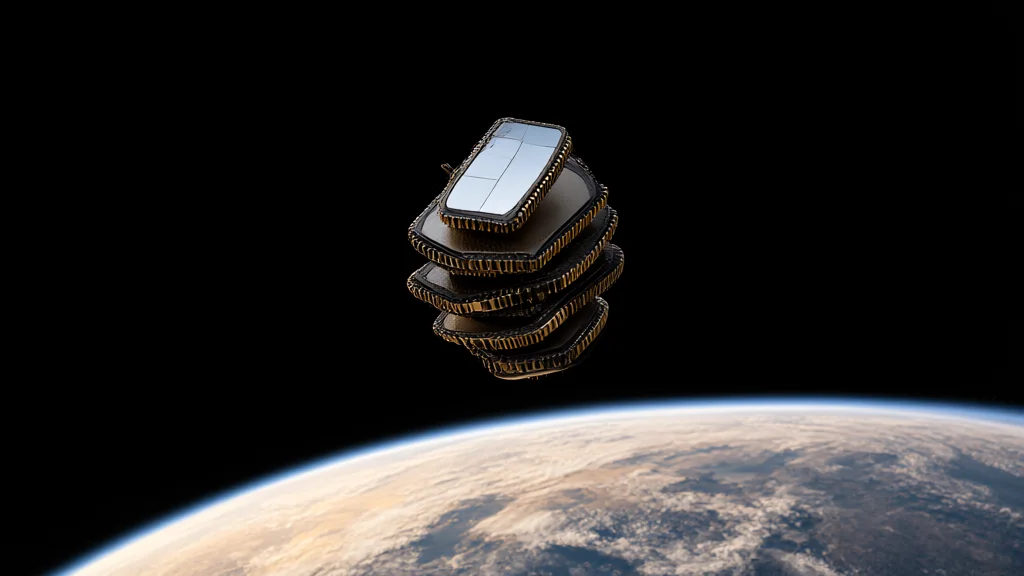
On October 1, Google's prototype satellite, dubbed MVP, will be aboard a SpaceX Falcon 9 as part of the Transporter-18 rideshare launch from Vandenberg Space Force Base near Santa Barbara. That is according to The New York Times, which says Google gave the paper the first look inside the project. The satellite was developed in collaboration with the space company Planet Labs, and according to Gizmodo it carries four Google TPUs of the Trillium generation.
These are standard AI chips, the kind that normally run servers on the ground, not purpose-built spaceflight hardware. That is the whole point of the experiment: Can ordinary compute equipment survive the launch and the radiation of low Earth orbit at all?
Google itself stresses that this is not a full data center. The company described it to The New York Times as an experimental version of a data center, and the paper writes that the satellite has enough computing power to answer simple AI queries from space. Secondary sources, such as Android Headlines, describe the mission as strictly a proof of concept – the precise in-orbit role of the computing work is not fully pinned down.
Three Things Being Tested
The mission comes down to three physical challenges.
The launch. The rocket ride subjects the vehicle to intense vibrations. The figures differ between sources: Gizmodo reports that the roughly ten-minute ride subjects the satellite to forces of up to ten times Earth's gravity, with some components briefly at 50 to 100 times gravity, while Android Headlines cites forces of up to 100 times gravity. None of these figures are independently verified. What is established is that the satellite has already passed a vibration test at Planet Labs' facility in San Francisco, as The New York Times describes.
The radiation. In orbit, high-energy protons continuously bombard the electronics. Google says the Trillium chips were exposed to a proton beam at the Crocker Nuclear Laboratory at UC Davis – while the chips ran AI workloads, Gizmodo reports. According to the company's own blog post, quoted by People, the chips "hold up remarkably well, and can survive a radiation total ionizing dose greater than what they would receive during a five-year space mission." This too is a company claim, not an independently verified result.
The heat. Cooling is the third challenge, and Google is working on approaches including heat pipes and radiators, according to Gizmodo. This is also where the prototype's real limitations lie: Android Headlines reports that the four TPUs can only run AI workloads for roughly 15 minutes at a time before shutting down to prevent overheating. The figure appears only in secondary reporting and should be taken with that caveat – but even if accurate, such a duty cycle is an experiment in thermal management, not a data point for orbital scale.
The Roadmap: Laser Links in 2027, a Cost Threshold in the Mid-2030s
Suncatcher is intended as a multi-stage program. Google unveiled the project in November 2025, with the goal of launching two prototype satellites by early 2027 that will "test our hardware in orbit, laying the groundwork for a future era of massively-scaled computation in space," People writes, citing the company's announcement.
The next step is about communication. The satellites are to be connected via laser links, a task the company describes this way: "Maintaining the necessary connection requires extraordinary precision, similar to hitting a coin-size target from miles away while both points are in motion. We'll test our work on this in 2027 when we put two satellites in orbit."
Google is also aware that the economics are decisive. The company's own research estimates that launch prices must fall below roughly $200 per kilogram before an orbital data center can compete with a ground facility on energy costs – a level the company itself believes could be reached around the mid-2030s, according to Teslarati. These are Google's own estimates, not established economics, and they depend on launch prices continuing to fall sharply. Behind them lies another company claim: satellites in low Earth orbit could, according to Google, generate up to eight times more solar power than on Earth.
The Headwind on the Ground
It is worth noting how cautiously Google itself frames this. James Manyika, Google's senior vice president, said according to The New York Times: "We don't expect, to be perfectly frank, that we'll have anything usefully operational in the next few years." He drew the parallel to the company's work on driverless cars, which took 15 years of research before anything came to fruition, People writes, citing the paper.
External voices diverge all the more. Elon Musk has lent the concept his support: "The amount of compute in space will obviously round up to 100% of all compute," Musk wrote on X in response to a video about Project Suncatcher, Fox News Digital reports. Between an entrepreneur envisioning all computation moving into space and an executive who expects many years lies Google's far more measured timeline.
What the Launch Will Prove – and What It Won't
If all goes as planned on October 1, the mission will show that commercial AI chips can survive the physical launch after a passed vibration test, and it will give Google real data on radiation and thermal behavior that no ground test can fully replicate. According to The New York Times, it would be the first step toward that goal by a major tech company.
It will, however, say nothing about scale. One prototype satellite with four chips and limited run time cannot test Suncatcher's central claim, namely that space can compete with the ground on energy costs. The two laser-link satellites in 2027 are meant to test the next bottleneck, communication between satellites, but that too is basic research measured against the requirements of an operational data center.
And one question remains: if MVP's thermal or radiation behavior in orbit diverges from the ground tests, the whole roadmap must be reconsidered. For now, October 1 is a scheduled date, not a confirmed outcome – launches can be delayed. The only thing that is certain is that Google is now placing its four TPUs on a Falcon 9, and that even the company itself expects many years before there is anything usable in orbit.