

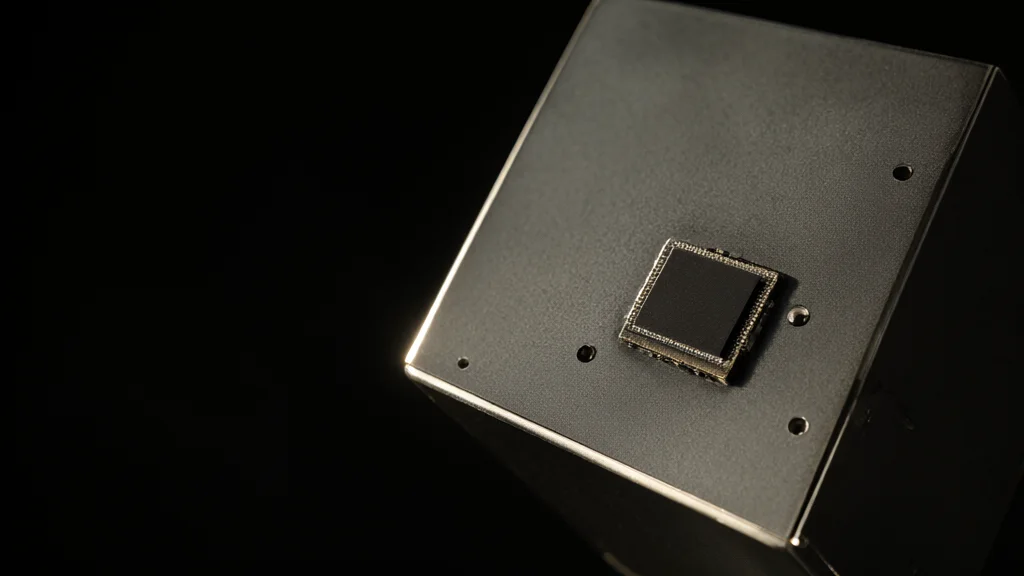
Google's Suncatcher Satellite With Four TPU Chips Is Set to Launch October 1
Google announced on September 24, 2026 that the first Project Suncatcher prototype satellite is scheduled to launch October 1 on SpaceX's Falcon 9 Transporter-18 — the first test of TPUs in orbit, and a concrete step toward the company's vision of AI data centers in space.
What's happening
October 1, 2026 is the scheduled launch date for Google's first Suncatcher satellite, on SpaceX's Falcon 9 Transporter-18 rideshare mission, according to Aviation Week. In an update published September 24, Google wrote that the launch was planned for "the following week," developed in partnership with satellite company Planet, per Pulse 2.0. The date is scheduled, not confirmed — rideshare missions often slip.
The purpose is put plainly by Google CEO Sundar Pichai himself: "Can our TPUs survive and operate in space? Well, we're going to find out," he told Aviation Week. In other words, this is not an established function being scaled — the entire point of the prototype is to determine whether Google's chips can be used in orbit at all.
What's actually flying
According to Ars Technica, as cited by 24/7 Wall St., the satellite is dubbed MVP and is roughly the size of a refrigerator. Google integrated its four TPU accelerators into a satellite Planet Labs had already built. Planet Labs is a satellite imagery company and is Google's partner on the mission.
Operations will be modest. Ars Technica, citing The New York Times, reports that the solar panels deliver around one kilowatt — enough to power a microwave oven or a hair dryer. Google will run Gemini models on the chips, but only in bursts of about 15 minutes before shutting them down so the radiators can shed heat. The planned lifetime is just a few months. The details on size, power draw, and operating bursts are thus not independently confirmed — they come through several layers of secondary coverage (24/7 Wall St. citing Ars Technica, which cites The New York Times).
It's worth keeping that framing in mind: this is not a mini data center in orbit. It is a hardware test with four chips that get to work a quarter hour at a time.
Why space at all
Google's core argument is power. "If you put a solar panel in the right orbit, it generates five to eight times more power than the same panel down here on Earth," Travis Beals, Suncatcher's project lead, told Aviation Week. That is a specific claim from Google — not an independent measurement — and the company's own statements vary slightly: in other contexts Google has said satellites in low orbit can generate "up to eight times" more solar power, while Beals gives a range. The range is the more precise figure.
The right orbit means the solar panels are exposed to sunlight nearly constantly, with no atmosphere or clouds to attenuate the intensity. With the right orbits and large enough amounts of power, one can imagine a data node where the power supply is abundant and cooling — eventually — happens by radiating heat into the cold of space.
The vision behind it is large. "Future designs of our satellites will each carry dozens of TPU chips while orbiting the Earth in clusters," Google said in a statement to Aviation Week. The clusters are to be networked together with laser links. But there is a long road from there to where the MVP is now, and the next step is already planned: according to Aviation Week, Google says two new satellites will launch in early 2027 to validate laser links between satellites. Until that demo works, any cluster is a thought experiment.
What Google has proven — and what it hasn't
Everything Google can point to before launch is ground testing.
- Radiation: Google tested Trillium TPUs at the Crocker Nuclear Laboratory at UC Davis with a proton beam. According to Google, the chips survived a total radiation dose larger than they would typically encounter over a five-year space mission — the company describes the chips as having held up "remarkably" well, per Gizmodo's account.
- Vibration: Google's engineering team ran vibration tests along all three axes, and the hardware withstood them, per Pulse 2.0.
- Thermal vacuum: Cooling uses a combination of heat pipes and radiators, according to Google's blog post, quoted by Gizmodo. That solution was tested in a thermal vacuum chamber — a simulation of space without actually being there.
The next step is the toughest test of all: the launch itself. Google says the rocket ride exposes the satellite to strong vibrations and forces of up to ten times Earth's gravity, and that individual components — including the TPU chips themselves — may briefly experience forces of 50 to 100 times gravity. And even if the hardware survives launch, it remains an open question whether the chips work in orbit: radiation over time, thermal behavior in microgravity, and whether the chips tolerate actual space conditions rather than simulated ones.
All of this, then, is Google's own claims about its own chips. None of the test results have been independently verified.
The context: Google is not alone
Suncatcher is not the first attempt at AI computing in space. Starcloud already launched an Nvidia H100 GPU into orbit in November 2025, according to Gizmodo. SpaceX this year has made space-based AI infrastructure a central part of its IPO pitch, according to the same source. The field is thus in an early but not lonely phase — several major players are independently betting on the same underlying thesis that power and cooling are cheaper in orbit than on Earth.
For Planet Labs, the mission is a visible validation of the company's satellite platform in a new role. The stock rose 7.57 percent on Thursday and 3.18 percent in pre-market trading Friday, according to CoinCentral — figures that are not independently confirmed, and which should not be read as carrying much weight.
The distance from prototype to data center
The numbers speak for themselves: one kilowatt versus the megawatt scale a modern AI data center factory requires. Fifteen minutes of operation versus continuous running. Four chips versus dozens per satellite in Google's future designs — which are, in any case, future designs and not something that exists today. Thermal management is particularly unsolved: Google is still working on "several different approaches," according to its own blog post.
Can an orbital data center be expected "overnight"? No, according to Entrepreneur, which writes that experts — unnamed — believe such facilities are years from commercial viability. That is a vague source, but it points in the same direction as the concrete timeline: first one hardware test, then a laser-link demonstration in 2027, and then — at best — design work on the actual cluster satellites.
So what is actually being settled this week is very concrete, and yet fundamental: whether Google's own chips can work at all in an environment they were never designed for. "We're going to find out," Pichai said. Until that answer exists, everything else — solar power multipliers, clusters, data centers in orbit — is a plan.