

Google's TPU is in orbit – but the price tag requires around 1,800 Starship flights, according to Google
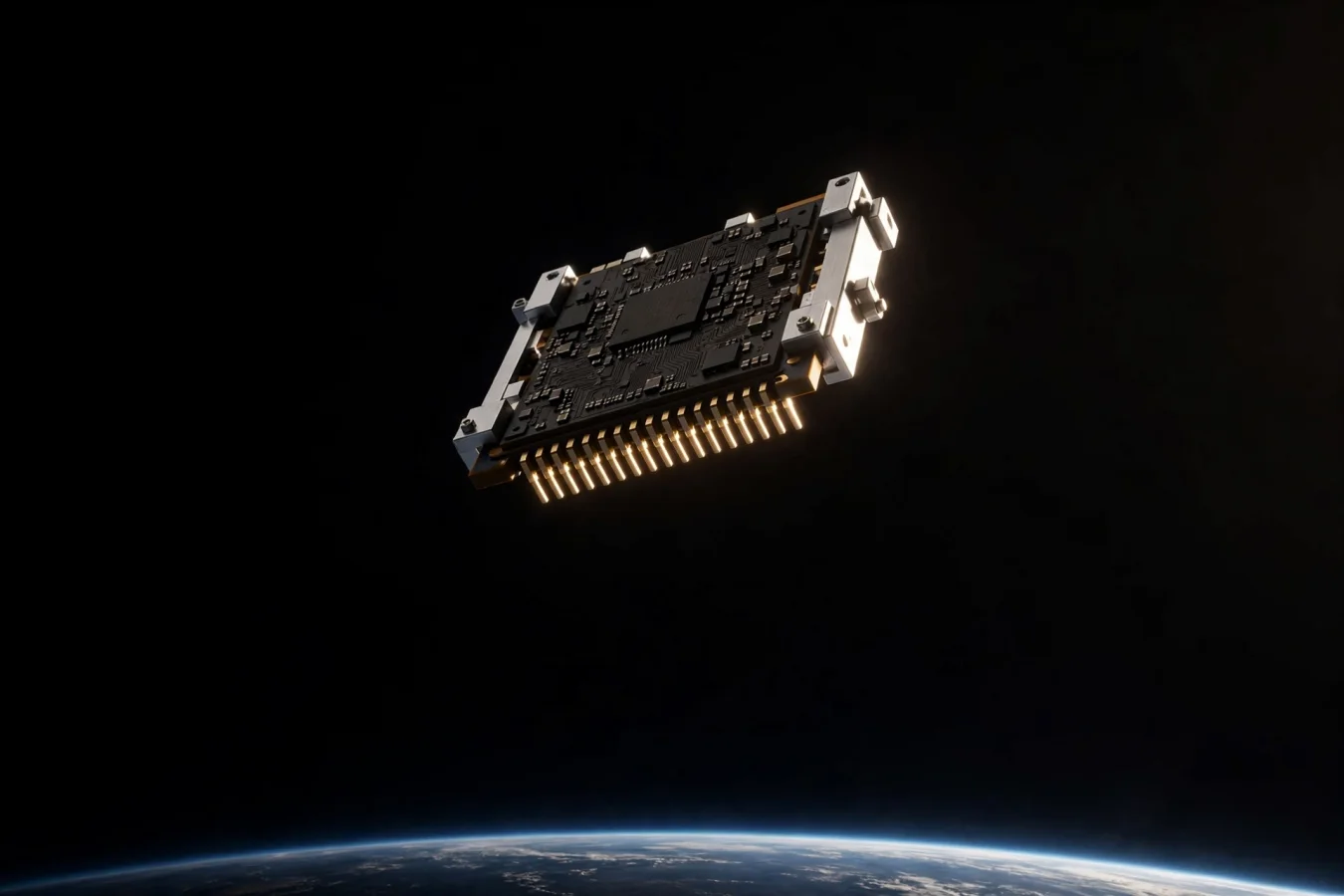
On October 1, 2026, SpaceX launched a satellite carrying Google's AI chips into orbit from Vandenberg in California – according to TechCrunch, the first time Google has sent one of its own advanced chips into space.
On October 1, 2026, SpaceX launched a satellite carrying Google's AI chips into orbit from Vandenberg in California – according to TechCrunch, the first time Google has sent one of its own advanced chips into space. The same day, the company published a peer-reviewed version of its working paper on orbital data centers, which projects launch prices approaching $200 per kilogram by 2035 – but the assumptions are demanding: around 1,800 Starship launches over ten years.
What happened
The prototype satellite was launched aboard a SpaceX Falcon 9 on the Transporter-18 rideshare mission from Vandenberg Space Force Base in Santa Barbara County, California. According to CNBC, the launch window opened at 11:15 a.m. local time, the liftoff went off without incident, and all payloads were deployed by around 1 p.m. local time. According to CNBC, Google's Travis Beals confirmed, via a blog post, that contact with the satellite had been established and that it was operating as expected.
For Project Suncatcher – a "moonshot" initiative Google first unveiled in November 2025 – this is the first concrete hardware milestone, CNBC reports. TechCrunch describes the launch as the first time Google has sent one of its advanced chips into space.
What is actually in orbit
The satellite was developed in collaboration with the satellite company Planet and is roughly the size of a small refrigerator. It carries four of Google's own TPU chips, which together have the computing power of a single data center server – a figure reported by several outlets, including Scientific American and Smithsonian Magazine (citing the New York Times). TechCrunch refers to the chip in the singular, and none of the sources in this story are Google's own documents, so the chip count should be read as repeated across several media outlets, but not primarily confirmed.
The mission is a trial run, not an operational day: the satellite is set to run Google's Gemini models in 15-minute sessions at a time, before the chips are switched off and cooled down. The reason is simple physics – in a vacuum, it is difficult to get rid of heat, and the satellite uses specialized radiators to manage it. The 15-minute cycles exist to avoid overloading the power and thermal management systems, according to TechCrunch and Scientific American.
The working paper released the same day
On launch day, Google also released a peer-reviewed version of its white paper on orbital data centers, which is to be published in the journal Joule. TechCrunch describes it as one of the most thorough available analyses of how computing capacity could reach orbit – but the numbers are Google's own projections, not established facts.
The core assumption is a learning curve of roughly 20 percent per year, based on how much payload Falcon 9 has launched. For launch prices to approach $200 per kilogram by 2035, Google calculates that Starship would need to fly 370,000 tonnes of payload to orbit. That corresponds to around 1,800 launches over ten years – 180 per year – and it assumes each flight can carry 200 metric tonnes, according to TechCrunch's summary. Google's authors themselves stress, according to TechCrunch, that this is not a study of economic feasibility, but a projection built on a series of conditional assumptions.
The radiation tests that had to be redone
It is not only the economics that pose problems. Google had to redo particle accelerator tests of the chips after discovering that the original configuration gave the chips more shielding than they will actually experience in orbit, according to TechCrunch.
The corrected results point in two directions. The error rate is described as very low for typical inference – that is, running finished models – but problematic for large-scale training. Google expresses, according to TechCrunch, confidence in a five-year lifetime for the satellite. Google's conclusion, then, is that the chips are suited to inference in space, but not to training the biggest models up there – at least not with today's numbers.
The road ahead
The refrigerator-sized prototype is only the first step. Next year, a two-satellite demo is to fly with specially built satellites connected by laser links, according to TechCrunch and CNN. In 2027, Google plans two more satellites. The long-term path is far more ambitious: an orbital data center as a network of 81 satellites in tight formation, processing in parallel.
Why this is even on the table
The demand side is the simplest part of the equation. According to a report from the International Energy Agency, cited by Scientific American, data centers are expected to use around 3 percent of the world's electricity by 2030 – roughly a doubling of today's share. That is the backdrop for companies like Google exploring whether part of computing can be moved out of Earth's data centers.
But the distance from one refrigerator-sized prototype running Gemini in 15-minute sessions to 81 satellites in formation with sufficient laser-based communication is considerable. Google's own projection shows how demanding the price path is: even a trajectory toward $200 per kilogram by 2035 assumes, according to the math, that Starship flies around 180 times a year for ten years. Everything in this story rests on secondary sources' rendering of Google's material, not the company's own documents, and there is as yet no independent verification of either the launch math or the radiation results. The next milestone – the two-satellite demo with laser links – will show whether critical parts of the concept actually work in practice.