

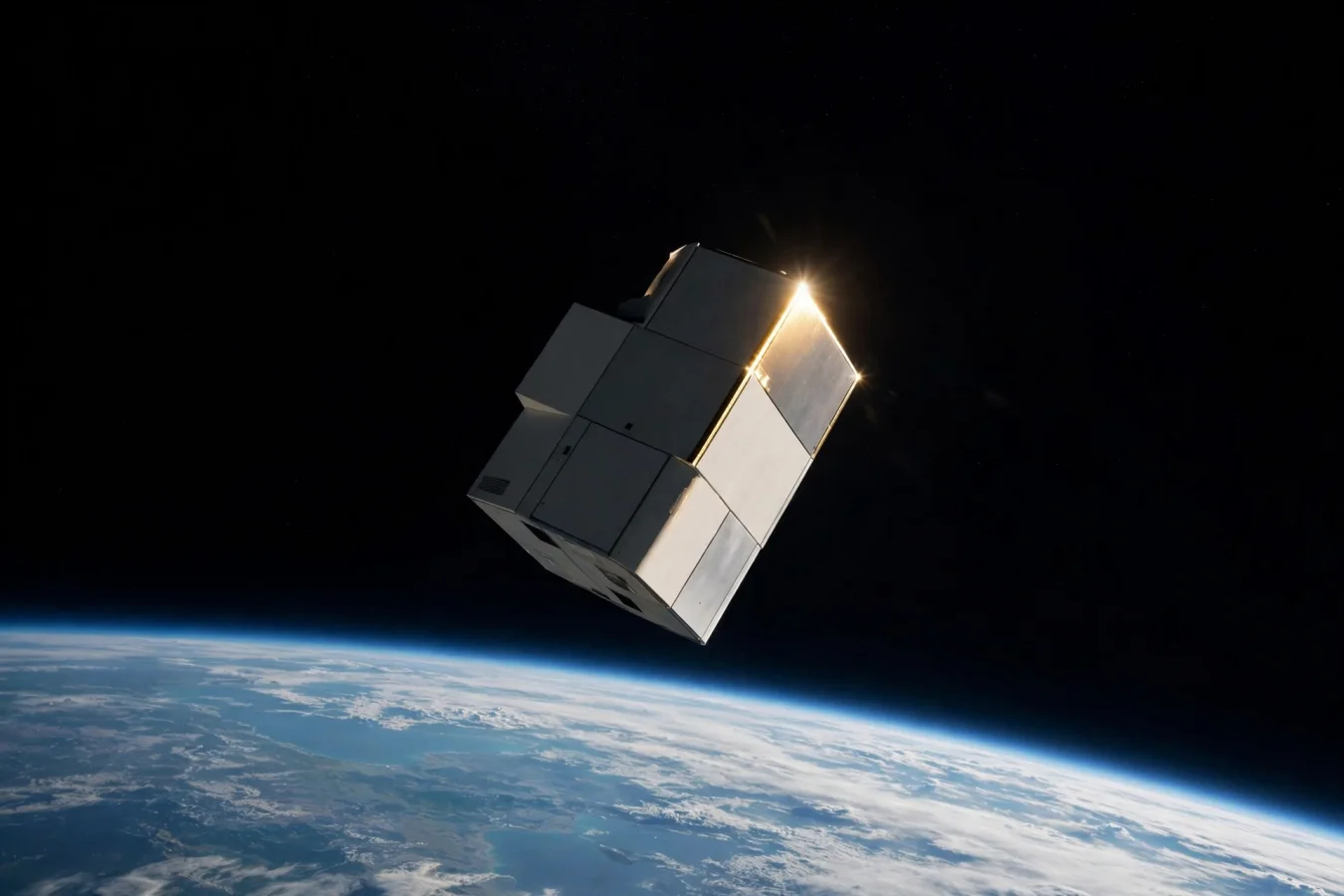
Google sent TPUs into orbit – first test of data center hardware in space
On October 1, 2026, Google launched a refrigerator-sized test satellite into low Earth orbit — the first hardware under Project Suncatcher, the company's long-term bet on placing data centres in space. On board are four custom TPU chips set to run Google's Gemini AI model in short 15-minute sessions before being switched off to cool down. The test is small, and no results are available yet — but it marks the transition from concept to concrete hardware.
What Was Actually Launched
According to Smithsonian Magazine, drawing on reporting by Kate Conger and Cade Metz in The New York Times, Google sent a refrigerator-sized test satellite into low Earth orbit on October 1. The satellite was developed in partnership with satellite imagery company Planet and got a ride on a SpaceX rocket.
The payload consists of four custom tensor processing units (TPUs) — Google's own special-purpose machine learning chips. Together they have the computing power of one server in a data centre. For perspective: the largest data centres contain more than one million servers. Simply put, Google has placed one server's worth of AI computing capacity in orbit, not a data centre.
How the Test Works
The chips are to run in 15-minute sessions. During these windows, they can run Google's Gemini AI and process short queries. They are then switched off to cool down.
The operating cycle says something about the challenge: heat management is one of the main problems for computing in space, where there is no air or water for convective cooling. That the tests are planned as short pulses followed by cooldown suggests thermal management is among the things to be mapped — but the sources do not explicitly state this is the main purpose, so it should be read as a reasonable interpretation of the setup, not a confirmed explanation.
The test is thus meant to answer practical questions: Do TPUs work in the space environment? Can they withstand radiation and thermal swings? How does the hardware behave under real conditions in orbit?
Google's Rationale
Google itself frames the test as exploratory. "This first launch is about seeing what works, identifying failure points and applying the findings to future missions," wrote Travis Beals, Google's senior director of paradigms of intelligence and head of Project Suncatcher, in a statement on September 24.
The long-term goal, as relayed by Smithsonian, is to place the infrastructure that powers Google's AI models in orbit, so that the systems can be powered by sunlight. In low Earth orbit, solar energy supply is far more consistent than on the ground, where clouds, night and seasons limit solar farms — this is the premise on which the entire venture rests. The available sources say little about the precise orbital geometry and energy calculations, however, and Google's claims about the solar energy potential are the company's own statements, not independently verified facts.
The Scale: One Server Rack Versus One Million
The gap between what is demonstrated and what is sought is enormous. One server rack in orbit, the size of a refrigerator, is to be measured against data centres housing more than one million servers. Scaling from four chips to fleets of satellites involves challenges the test can neither illuminate nor rule out: launch costs per kilogram, maintaining hardware no technician can reach, communication capacity down to the ground, and the lifespan of electronics in a radiation environment.
Smithsonian reports that Google "ultimately" wants to launch fleets of satellites, each carrying about a dozen [chips]. The details of this plan are, however, sparse in the available source material and should be treated with caution until they can be confirmed.
What Remains Open
While the test is in orbit, no results, cost figures or timelines have been made public yet. There are no numbers on how well the TPUs perform, what the project costs, or when Google might scale up. Much of what is known about the project comes from secondary reporting — Smithsonian building on The New York Times — and from Google's own statements, not from independent documentation.
It is worth keeping in mind: what was actually demonstrated on October 1 is the launch of test hardware. Whether solar-powered AI infrastructure in space will ever be economically or technically feasible remains an open question — and at best, this satellite can begin to answer some of the most fundamental sub-questions.