

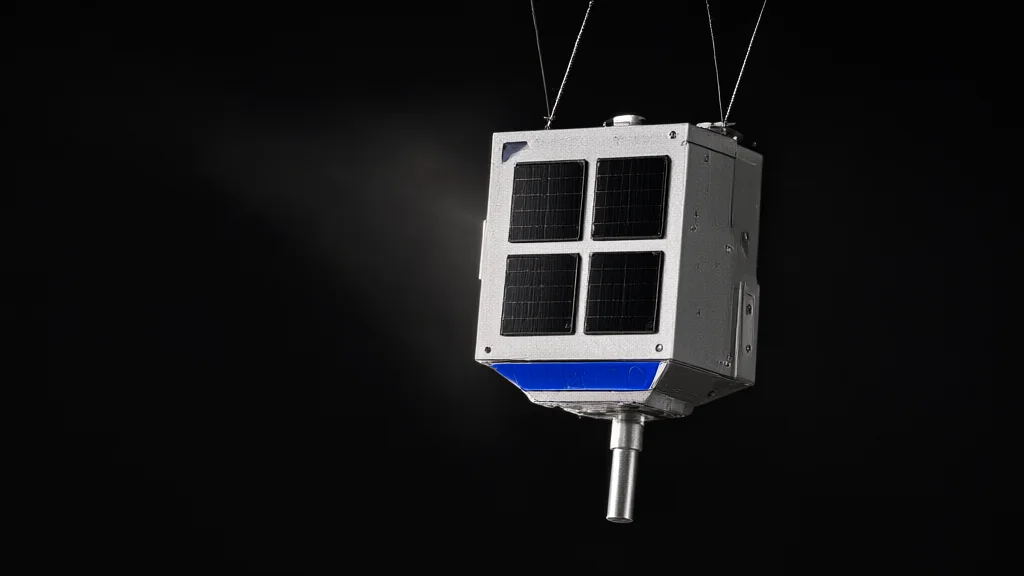
Google to launch prototype satellite carrying four TPU chips on October 1
On October 1, if the schedule holds, Google will send its first prototype satellite carrying AI chips to orbit from Vandenberg Space Force Base in California.
But while the project is called Project Suncatcher and dreams of data centers in space, what actually goes into orbit is modest: four TPU chips with roughly the computing power of a single server, and a cooling system that can handle about 15 minutes of operation at a time.
What is supposed to happen
According to The New York Times, which says it received the first inside look at the project from Google, the satellite — dubbed MVP — is to be loaded onto a SpaceX Falcon 9 at Vandenberg Space Force Base near Santa Barbara and launched into orbit on October 1. It is the first concrete step in Project Suncatcher, a research project Google announced in November 2025, with the long-term goal of placing solar-powered AI data centers in low Earth orbit (NYT).
It should be stressed: the launch is planned, not confirmed as completed. Fox News has also pointed out that Google's published plan does not confirm the timeline in an X post claiming a launch "next week"; Google's published plan instead describes two prototype satellites with partner Planet by early 2027 (Fox News).
What the satellite actually is
The scale is deliberately small. MVP carries four so-called tensor processing units (TPUs) that together provide the power of a single server in a data center, driven by roughly one kilowatt from solar panels, Engadget writes, citing the NYT (Engadget). The plan is for the satellite to answer simple AI queries for about a year, while it circulates for around six years before burning up in the atmosphere.
Several of the technical limitations show how early-stage this is. A proprietary cooling system that channels heat out into space through layers of conductive material only works for about 15 minutes before the chips must be shut down to cool. And for radiation-induced bit flips — when cosmic radiation changes individual bits in memory — Google's planned solution is as primitive as restarting the chips.
What the mission is actually testing
MVP is first and foremost a data-gathering mission. Google has tested the TPUs while running AI workloads at a facility at the University of California, Davis, but the company itself says testing in orbit is necessary to understand how the hardware behaves in the real environment (Economic Times).
Some things have already been done on the ground. At UC Davis's Crocker Nuclear Laboratory, tests showed, according to CoinCentral's account of Google's results, that the chips survived more radiation than they would typically be exposed to over five years in orbit (CoinCentral). The satellite has also passed a vibration test simulating the launch — the screws stayed in place and the chips were intact. James Manyika, Google's senior vice president for research, called the results "great," but said he still wondered what would happen when the satellite got out into space (NYT).
All of these results are the company's own figures relayed through secondary sources; no primary documents have been published in the available material.
The plans — and why Google itself is tempering expectations
Google says that satellites in low Earth orbit receive nearly constant sunlight and can generate up to eight times more solar energy than panels on the ground — a company claim that has not yet been proven in practice (Cryptopolitan). The roadmap continues via two satellites with Planet by early 2027 to test laser links between satellites, then a long-term goal of 80 satellites in close formation, and exploration of a satellite roughly the size of a football field (Engadget). Google's investment in the project has not been disclosed.
But Google's own top researcher is tempering expectations: "We don't expect, to be perfectly frank, that we'll have anything usefully operational in the next few years," Manyika told Engadget. Experts cited by the Economic Times point to high launch costs, technical limitations and bottlenecks in satellite production, and believe the concept is years away from commercial viability. For context: a single Falcon 9 launch costs around $74 million.
Not everyone is as cautious. Elon Musk replied on X to a video about Project Suncatcher with the prediction that nearly all computing power will move to space — a position in sharp contrast to both Manyika's timeline and the expert assessments, and one that should be read as a stance, not a documented basis. The rights to build this future are, moreover, already contested: SpaceX has asked the FCC for approval of up to one million data-center satellites to train xAI models, and Blue Origin has asked to place nearly 52,000 solar-powered satellites for AI computing (Cryptopolitan). Set against that, Suncatcher is an opening move in a race, not a mature product.
The market reaction so far has been muted: Alphabet stock rose around 0.5 percent in early trading after the announcement (CoinCentral).
What to watch for
The crucial thing about MVP is not the answers to any queries, but the telemetry: how the chips actually handle radiation in the real radiation environment, whether the cooling system holds up for those 15 minutes in vacuum as it did in tests, and how often the restarts for bit flips will need to happen. If the ground tests hold up in orbit, Google has a data foundation for the next two satellites. If they don't, the company will at least know where the concept fails — before competitors spend far larger sums finding out.