

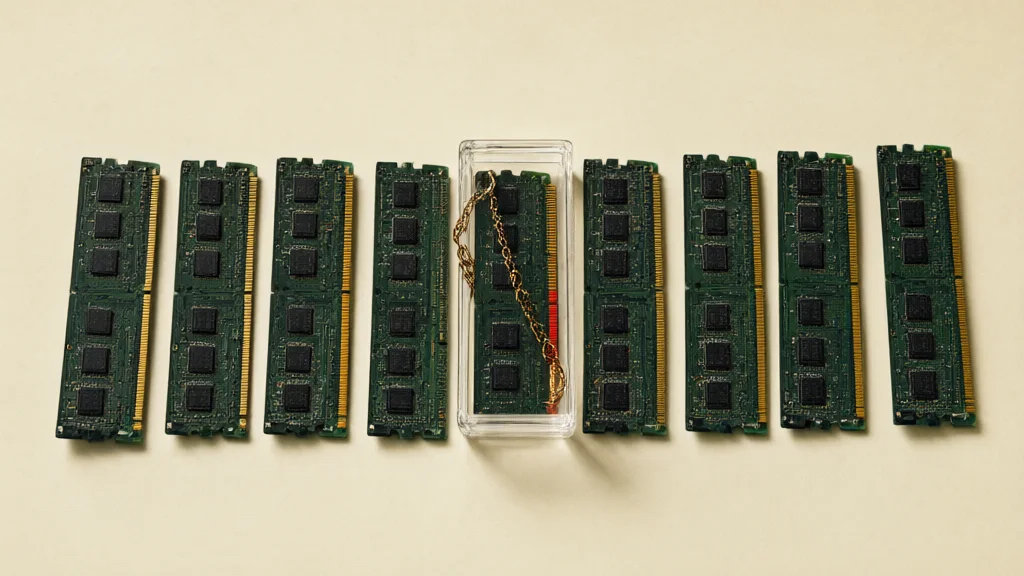
Memory shortage from the AI boom pushes smartphone prices up 15 percent globally
On 1 October 2026, Xiaomi launched the Redmi 17C 5G in India at 20,999 rupees for 4 GB of RAM and 128 GB of storage — roughly 68 percent more than its predecessor cost at launch, with an older chip and otherwise identical equipment. Behind the prices lies a global memory chip shortage driven by demand from AI data centers.
An upgrade that got more expensive and weaker
The Redmi 17C 5G is a concrete example of an industry-wide trend. The previous generation, the Redmi 15C 5G, launched in India in December at 12,499 rupees for the same memory configuration. The cheapest 17C model thus costs roughly 68 percent more, while running on an older MediaTek Dimensity 6300 instead of the Dimensity 6400 — and keeping the same battery, charging speed and camera resolution. That is according to Memeburn's coverage of the launch (Memeburn).
The trend goes further back. The Redmi 14C 5G launched in India in January 2025 at 10,999 rupees for the same 4 GB/128 GB tier, according to Business Standard, as reproduced by Memeburn. That means the same memory tier in Redmi's C-series has nearly doubled in price in under two years.
Xiaomi has also raised the price of the already-launched Redmi 15C 5G from 12,499 rupees at its December launch to 16,999 rupees in June — an increase of 36 percent (Rest of World). Note that Xiaomi has not tied the Redmi 17C price increase to any single cost; the link to the memory shortage is reporting and analysis, not an official explanation from the company.
The mechanism: memory is going to the data centers
According to Ramon Llamas, research director for mobile devices at IDC, it comes down to where the memory is being taken from: "There are three primary manufacturers of memory, and in late 2025 all of them turned the vast majority of their supply toward AI centers instead of consumer electronics. That left a lot of companies scrambling for inventory. … The shortage of memory has driven up memory prices, and those price increases have been passed on to the consumer," Llamas told Rest of World.
On Micron's fourth-quarter fiscal-year earnings call, president and COO Manish Bhatia offered a more technical explanation, as reported by TechRepublic via Chosun Biz: HBM chips (high bandwidth memory) are used for AI and are growing faster than commodity DRAM, and the "trade ratio" — how much production capacity each HBM chip requires — increases as manufacturers move from HBM3E to HBM4 and HBM4E. In other words: each HBM chip consumes more production capacity than commodity DRAM, and that spills over into the memory supply for consumer electronics.
The numbers behind the trend
Rest of World reports that prices of existing smartphone models have risen about 15 percent globally this year, while newly launched models are roughly 25 percent more expensive than last year. The regional differences are large:
- India: +21 percent
- Asia-Pacific: +19 percent
- Middle East and Africa: +18 percent
- United States: +5 percent
These figures and the Omdia data below are drawn from Rest of World's reporting; the underlying methodology from the research firms has not been published in that coverage.
The entry level is shrinking
The consequence is clearest in the cheapest segment. According to Omdia, Oppo's sub-$100 shipments in Southeast Asia fell by 96 percent, and Vivo moved its main entry-level model above $100 in most markets. In Africa, where 81 percent of smartphones shipped last year cost under $200, sub-$100 phone shipments fell 34 percent year over year in the second quarter of 2026.
Ivan Lam, senior analyst at Counterpoint, points out that Chinese manufacturers — which account for roughly 60 percent of all smartphones shipped globally — have "drastically reduced" their entry-level projects this year because memory costs have risen. Nor does he expect costs to return to pre-2025 levels: "What used to be below $150 may become below $250, or even $300," Lam told Rest of World.
How long will it last?
Micron has delivered a warning that the crunch is not temporary. CEO Sanjay Mehrotra said in prepared remarks for the earnings call that the company "expects memory and storage supply-demand conditions to be much tighter in calendar 2027 and 2028 than they were in 2026" (TechRepublic). More than 75 percent of Micron's planned production for fiscal year 2027 is already committed, and most discussions with new customers concern 2028 volumes.
The premium market confirms the picture
It is not just cheap phones that are affected. Bloomberg, via Moneycontrol, reported that Samsung has raised prices across the Galaxy S26, S26+ and S26 Ultra — each up by $100 — citing the broader cost pressures that the persistent, AI-driven memory shortage creates for consumer electronics manufacturers (Moneycontrol). This is Bloomberg attribution; an official company statement is not available in this coverage.
Consequences for digital inclusion
GSMA, the global industry organization for the mobile industry, has previously projected that nearly 800 million more people will use mobile internet by 2030. Claire Sibthorpe, head of digital inclusion at GSMA's nonprofit foundation, expresses concern that rising smartphone prices will affect this projection and widen the gap of digital inequality. This is an analytical and advocacy perspective from GSMA — not a measured outcome — but it points to who is hit hardest: first-time buyers in India, Southeast Asia and Africa, precisely where the price increases are largest and the entry level is disappearing fastest.