

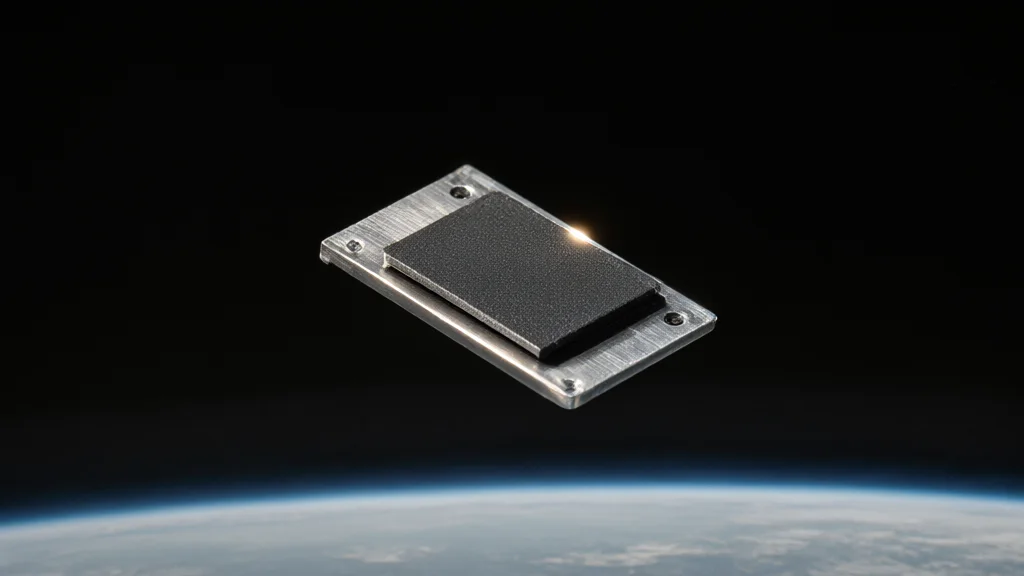
Project Suncatcher: Google to test whether Trillium chips survive radiation and vacuum in orbit
Google announced on Thursday 24 September 2026 that the prototype in its Project Suncatcher will head to space on 1 October, carrying four Trillium TPUs on board. The goal is not an orbital data center — not yet — but to find out whether ordinary AI chips can survive rocket launch, radiation and vacuum at all.
What is actually happening on 1 October
The prototype satellite, called MVP, is to be loaded onto a SpaceX Falcon 9 at Vandenberg Space Force Base in California and launched on 1 October, according to The New York Times (People). The mission is flying as part of Transporter-18, a rideshare launch in which many satellites share the same rocket, and the satellite was developed in collaboration with the satellite company Planet Labs (Gizmodo).
Sources confirm only the planned date — no launch time has been given, and there is no confirmation that the liftoff has taken place.
What the prototype will test
The hypothesis Google wants to settle is whether TPUs — the company's own accelerator chips for AI workloads — function under the conditions of low Earth orbit: the mechanical forces of launch, cosmic radiation, and the challenge of shedding heat in vacuum, where air cannot be used for cooling.
According to Engadget, citing the Times' reporting, the MVP carries four TPUs with combined compute roughly equal to a single server, supplied with about one kilowatt from its solar panels. The satellite will answer simple AI queries for roughly a year before spending a total of six years in orbit and finally burning up in the atmosphere (Engadget).
Cooling is the most visible constraint. Engadget describes a proprietary system of layers of conductive material that channels heat out into space — but it is expected to work for only about 15 minutes before the chips must be switched off to cool down. That figure comes from the Times' coverage, not from Google's own announcement, and should be read as a reported, not confirmed, figure: a prototype that can work in short sessions, not continuously.
The groundwork done on the ground
Much of the technical foundation has already been laid on Earth. Google has previously exposed Trillium chips to a proton beam at the Crocker Nuclear Laboratory at UC Davis — while the chips were simultaneously running AI workloads, so that their behavior under both radiation and load could be observed (Gizmodo). Google says the chips survived a radiation dose greater than what a typical five-year space mission involves.
Worth noting: Google has not announced a space-rated TPU. The Register points out that the mission uses existing Trillium accelerators, lightly modified, and that the entire ground test program exists precisely to answer whether that is feasible (The Register). That ordinary, commercial AI chips might be sent to space without fully purpose-built variants is partly the point of the experiment — and partly one of the big uncertainties.
Why orbit at all?
Google's rationale is about energy. "In low Earth orbit, satellites have access to near-constant sunlight, generating up to eight times more solar power than on Earth," Google wrote in its blog post on Thursday (People). Sunlight around the clock, without clouds or atmosphere, is the central economic premise for imagined orbital data centers: the energy is free and uninterrupted, while the counterparts on Earth — cooling, real estate, the power grid — are not.
The eight-times figure is, however, Google's own estimate, not an independent measurement, and it applies to a theoretical scenario at scale. The prototype launching on 1 October has a power budget of around one kilowatt — in other words, the power of a single server.
Next step: laser links in 2027
One satellite is an electronics experiment. An "orbital data center" presupposes that many satellites can link together with high bandwidth. Google therefore already plans to launch two satellites in 2027 to test the high-speed lasers the company hopes can one day connect clusters of satellites (Gizmodo).
That test is, in practice, more important than today's launch for the vision of orbital AI clusters, since data transfer between satellites is one of the unsolved problems.
The skepticism — including inside Google
Google itself is tempering expectations. James Manyika, Google's vice president for research, technology and society, said according to Engadget: "We expect, to be completely honest, not to have anything usefully operational in the next few years." He drew a parallel to the company's work on self-driving cars, which has been going on for 15 years (Engadget).
Brandon Lucia, professor of electrical and computer engineering at Carnegie Mellon University, told The New York Times that scaling is the entire challenge: "Expanding from one satellite to a vast network of them working as a giant data center will take years and enormous sums of money."
Analysts share the doubts. Gartner points to high launch costs, severe cooling bottlenecks and data transmission delays as the main objections to orbital data centers (Android Headlines). Gartner analyst Bill Ray, who has commented on the project earlier this year, went further, calling the concept "peak insanity," according to The Register — language that cannot be dismissed as hesitation, given that Google itself does not expect anything operational for several years.
The competitors are queuing at the FCC
The project is small compared with what other players have outlined. According to Cryptopolitan's reporting from February, SpaceX has asked the US Federal Communications Commission for approval to launch up to one million data-center satellites to train models for xAI. Blue Origin is reported to have filed for around 52,000 (Cryptopolitan).
Both applications are pending — not approved, and far less carried out. They nonetheless show that the idea of computing in orbit is no longer a thought experiment at a single company, but a field in which several companies are laying plans for large satellite fleets.
What to watch for
The most concrete thing in the coming weeks is the launch itself: confirmation that the MVP reaches orbit on 1 October, and then how the four Trillium chips behave in the first months — whether they withstand the radiation in practice, and how the 15-minute cooling cycle plays out in operation. Only with the twin launch in 2027 will we get an answer to what most determines whether orbital AI data centers are realistic: whether satellites can communicate fast enough to compute as one machine.