

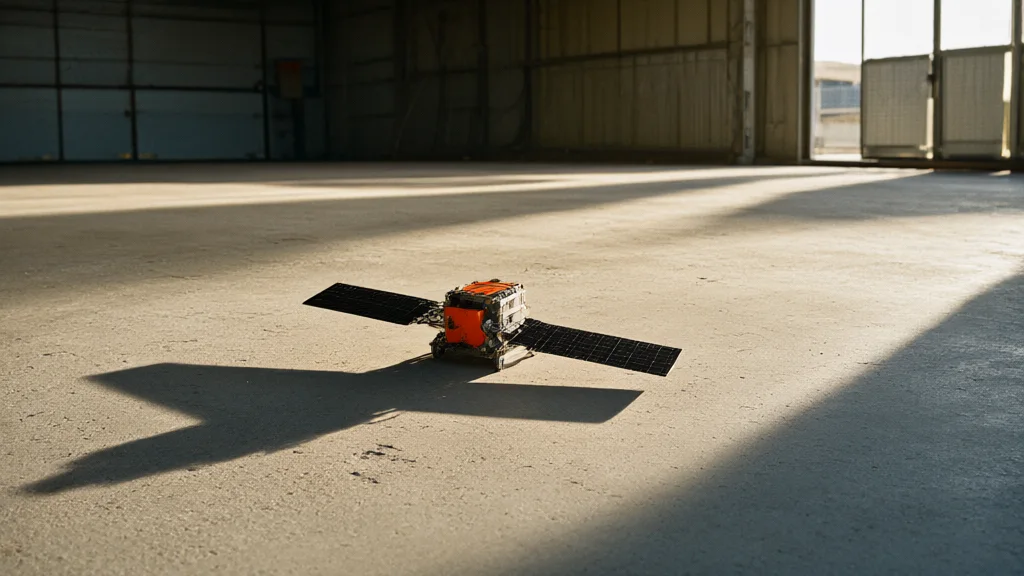
Project Suncatcher in orbit: Google's TPU satellite launched from Vandenberg aboard a Falcon 9
Project Suncatcher launched from Vandenberg on Thursday, October 1 aboard a SpaceX Falcon 9, with all payloads deployed within two hours. Google confirms contact with the satellite, and on the same day published a peer-reviewed version of its paper on orbital data centers. But everything about the operation so far is the company's own statements — and the first test results reveal a clear dividing line: radiation errors appear manageable for inference, but problematic for large-scale training.
What actually happened
The launch window opened at 11:15 a.m. local time (PT) from Vandenberg Air Force Base in Santa Barbara County, California, according to CNBC, citing SpaceX. The launch proceeded without incident, and SpaceX had deployed all payloads aboard by 1 p.m. local time the same day. Scientific American puts the launch time at approximately 2:32 p.m. EDT, and states that the satellite was placed into low Earth orbit. The rocket was a Falcon 9, and the mission was SpaceX's Transporter-18 — a rideshare launch in which Google's prototype flew alongside satellites from Planet Labs, among others.
This is what distinguishes this dispatch from earlier coverage: on Thursday, October 1, 2026, the plan of Google's "moonshot" project, first presented in November 2025, became a concrete satellite in orbit.
Google's status report — not an independent verification
A few hours after launch, Travis Beals, senior director of Project Suncatcher, wrote in a blog post: "Our team has confirmed contact with the satellite and it is operating as expected" (CNBC).
It is worth keeping this precise: this is Google's own status report, issued the same day as the launch, and nothing independent has confirmed it. No actual measurements from the TPUs in orbit exist yet — neither on thermal behavior, radiation effects, or computing performance. The only thing operational so far is that the satellite is responding.
Beals himself framed the project as an exploratory experiment. According to a Google press release quoted by CNN, he said the first launch is about seeing what works, identifying failure points, and applying the findings to future missions (CNN).
What the prototype actually is
The satellite is modest in scale. It carries four processors that are to run Google's Gemini models in 15-minute sessions before they must be shut down and cooled — a limitation meant to avoid overloading the satellite's power and thermal management (Scientific American, TechCrunch). The hardware is built on Planet Labs' standard satellite platform.
Before Google is allowed to test the TPUs, Planet is to put the satellite into operation and commission it. Beals called the prototype "a very minimal test" to verify that the chips can run in space at all. The operational target is one year (NPR via WVXU).
The orbit is sun-synchronous, meaning the solar panels are almost never in shadow. That removes the need for heavy batteries or backup power aboard — one of the design advantages Google's concept is built on.
The first real test result: radiation separates inference from training
The most concrete technical finding so far comes not from orbit, but from Google's updated radiation testing. The company states in the blog post that the chips "held up remarkably well" in ground tests at UC Davis, and that the data indicate they can tolerate more ionizing radiation than they would be expected to experience over five years in orbit (Scientific American).
But Beals himself drew the line between use cases in remarks to TechCrunch: "The error rate is very low if you're thinking about typical inference operations, right? Like one in a million" — the error rate is very low for typical inference operations, roughly one in a million, he said. "On the other hand, it was already problematic for doing, say, some mega-scale training run where you're going to have many thousands of chips running for months" (TechCrunch).
That means even if Google's own numbers hold, the radiation picture points first toward orbital data centers for inference — not for training large models. And this still applies at ground level: none of these rates have been measured in orbit.
Google's own economic math
On launch day, Google also published a peer-reviewed version of its whitepaper on orbital data centers, which is to appear in the journal Joule. TechCrunch describes it as one of the most thorough analyses that exist of how computing power could get to orbit — but it is still the company's own analysis, not an independent conclusion.
The core of the calculation is launch costs. The authors argue that rocket makers have achieved a price-reducing "learning curve" of roughly 20 percent per year since the Falcon 1 launched, and that launch prices near $200 per kilo by 2035 are reasonable to expect. But that is conditional on something dramatic: Starship flying roughly 1,800 launches over ten years. Without that launch cadence, the economics of the concept fall apart. For comparison, today's per-kilo prices to orbit are substantially higher, and no launch vehicle currently has a flight rate anywhere near what Google assumes.
What remains to be proven
Google plans to continue the research in 2027 with two new test satellites (CNN). Before that, there are three open questions this prototype is meant to answer:
Can the TPUs run at all? The actual tests of the processors have not started yet — Planet must first commission the satellite. All results from the chips in orbit are still in the future.
How do the chips behave over time? The ground tests at UC Davis and the error rates Beals cites come from ground testing. Real radiation behavior, thermal behavior, and performance degradation over months in sun-synchronous orbit are unmeasured.
Does the economics hold? The Joule article's figures of $200 per kilo and 1,800 Starship launches are Google's own projections, based on an assumed learning curve that must hold for a decade to come.
As long as actual measurements from the TPUs in orbit are lacking, the central claim of Project Suncatcher — that AI computing can be run economically in space — remains an unanswered question.